Eight Years On, Genocide Against Rohingya Persists
August 25, 2025 The Arakan Rohingya National Organisation (ARNO) today commemorates the 8th anniversary of the Rohingya genocide with a grave warning that the genocide is not over. Eight years after the Myanmar military’s brutal campaign in 2017, the remaining...
ARNO Expresses Concern Over Crisis Group Report’s Misrepresentation of Rohingya Realities
The Arakan Rohingya National Organisation (ARNO) expresses its strongest condemnation of the International Crisis Group’s Asia Report No. 348, titled “The Dangers of a Rohingya Insurgency,” published on 18 June 2025. The report is troubled with dangerous distortions,...
ARNO Mourns the Loss of 427 Rohingya at Sea and Demands Urgent Global Intervention
The Arakan Rohingya National Organisation (ARNO) is devastated by reports confirming the tragic deaths of an estimated 427 Rohingya men, women, and children in two separate boat disasters off the coast of Myanmar earlier this month. These devastating incidents, which...
RIP Pope Francis: Advocate for the Rohingya People
The Arakan Rohingya National Organisation is saddened to hear of the passing of Pope Francis, who passed away on April 21, 2025 from complications to his health. Pope Francis was widely regarded as a progressive world leader who stood up for marginalized people,...
ARNO Expresses Solidarity with Earthquake Victims in Myanmar
The Arakan Rohingya National Organisation (ARNO) extends its deepest condolences and heartfelt solidarity to all those affected by the devastating earthquake that struck central Myanmar on March 29, 2025. We mourn the tragic loss of life and express our sympathies to...
ARNO Calls for Justice and Action on the Fourth Anniversary of Myanmar’s Military Coup
Four years ago today, the military junta overthrew the peaceful elections which had taken place, and began a crackdown on civil liberties, human rights, and human dignity which continues until today. The Myanmar military, has ignored repeated calls to stop violence...
Press Releases
Letter of Condolence
It is with deep sorrow that we have learned about the passing of Prof. Zakaria, son of Maulana Turab Uddin, former Executive Member of the Rohingya Solidarity Organization (RSO). He passed away on 12th November 2025 at 12:30 PM in Cox’s Bazar, Bangladesh. Professor...
ARNO Expresses Gratitude for UK and US Renewed Support and Highlights Crisis in Rakhine State and Education Needs
Press Release October 2, 2025 The Arakan Rohingya National Organisation (ARNO) expresses deep appreciation to the United Kingdom for their generous renewed pledges of $36 million and to the United States for their generous pledge of $60 million, for Rohingya refugee...
Eight Years On, Genocide Against Rohingya Persists
August 25, 2025 The Arakan Rohingya National Organisation (ARNO) today commemorates the 8th anniversary of the Rohingya genocide with a grave warning that the genocide is not over. Eight years after the Myanmar military’s brutal campaign in 2017, the remaining...
ARNO Expresses Concern Over Crisis Group Report’s Misrepresentation of Rohingya Realities
The Arakan Rohingya National Organisation (ARNO) expresses its strongest condemnation of the International Crisis Group’s Asia Report No. 348, titled “The Dangers of a Rohingya Insurgency,” published on 18 June 2025. The report is troubled with dangerous distortions,...
IN THIS ISSUE
Contents
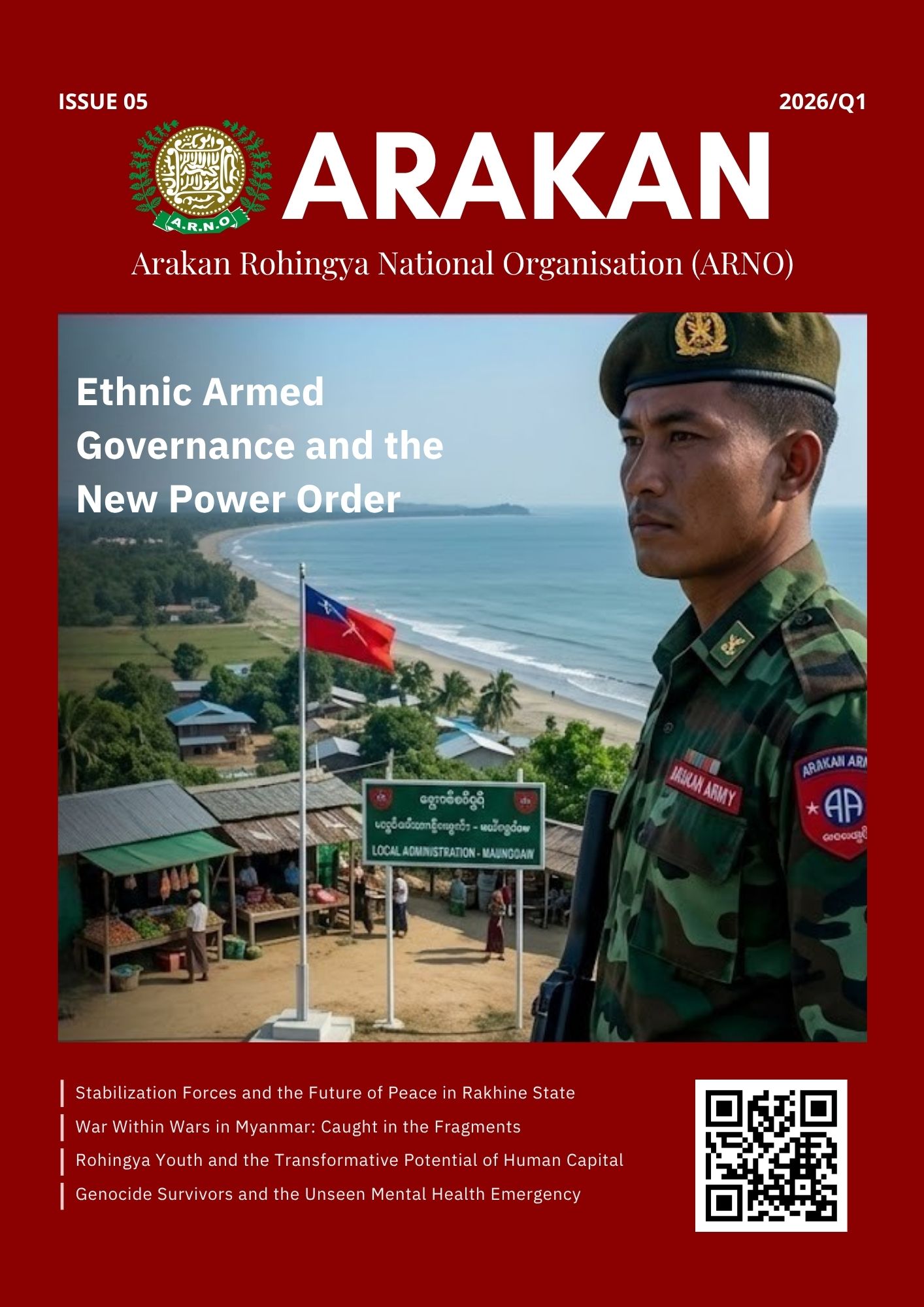
- Ethnic Armed Governance and the New Power Order
- Stabilisation Forces and the Future of Peace in Rakhine State
- War Within Wars in Myanmar and the People Trapped Between Them
- The Human Development Potential of Rohingya Youth
- Powerlessness as a Great Power in Moral Authority
- The Unseen Mental Health Emergency of Rohingya Survivors
- Narco War Fueling Genocide Against the Rohingya
- Rohingya News
- ARNO Policy Brief
Reports
Rohingya cautions UN Security Council over Chin Crisis – Do Not Repeat Mistake in Failing to Act
Joint Statement Date: November 1, 2021 We undersigned Rohingya community organisations today joined forces in calling on members of the United Nations Security Council not to repeat the mistakes it made in failing to act on warnings of an impending military offensive...
Rohingya Library
All ABOUT ROHINGYA
Press Release
ARNO calls upon South Asian Media to stop scapegoating Rohingya People
The Arakan Rohingya National Organisation (ARNO) immediately calls upon media outlets throughout South Asia to be responsible and ethical in their coverage of the violence which is taking place in Manipur and other parts of North India. Recently, media outlets are...
2 years after the Coup, the people of Burma are worse off
ARNO is saddened to continue to report that after two years of the coup which took place on February 1, 2021, by the Myanmar military (junta) that the conditions in Burma continue to deteriorate and have not improved. As the international community is aware, the...
ARNO condemns Junta award to Wirathu, terrorist and genocidaire
Today the Myanmar military (junta) awarded Buddhist Monk, Wirathu, the honorific title “Thiri Pyanchi” for “his outstanding work for the good of the Union of Myanmar” as reported by the junta’s information teams and subsequently reported by international media...
THE ROHINGYA GENOCIDE DAY WILL NOT AND CANNOT BE FORGOTTEN
(25 August 2022) The “Rohingya Genocide Day” of August 25 is a memorable day for our people and generations. For decades, the Myanmar brute forces and state-sponsored non-state actors have carefully pre-planned genocidal onslaughts against our innocent people....
Burma continues to suffer as a result of February 1, 2021 coup
February 1, 2022 The Arakan Rohingya National Organisation condemns the Tatmadaw’s illegal takeover of Burma/Myanmar since February 1, 2021. The international community is aware that one year ago, Tatmadaw, the military junta of Burma, perpetrated a coup against Daw...
Press Release: REMEMBRING ROHINGYA GENOCIDE
25 August 2021 Today is a most memorable day for us, for our children and for our generations to come. On this day of August 25, 2017, the Burma/Myanmar brute forces, army, police and state-sponsored non-state actors and Buddhist Rakhine vigilantes started pre-planned...
Press Release – Rohingya need international protection from ongoing genocide
16 August 2021 On January 23, 2020, the International Court of Justice (“ICJ”) issued an order in the case of The Gambia v. Myanmar requiring Myanmar to take measures to prevent the risk or possible recurrence of genocide against the Rohingya people and to preserve...
Statement of ARNO on the NUG policy Position on Rohingya in Rakhine State
On 3 June 2021 the National Unity Government (NUG) of Myanmar issued its “Policy Position on the Rohingya in the Rakhine State.” In response, the Arakan Rohingya National Organisation (ARNO) with the Rohingya people cautiously welcomed this development. The...
Military Coup in Myanmar: Two steps forward 10 leaps back
Press Release: 4 February 2021 Arakan Rohingya National Organisation (ARNO) condemns the military coup which has taken place in Myanmar on 1st February. The Rohingya were entirely disenfranchised throughout the entire election process and have lost all vestiges of...
International Donor Conference on Rohingya to take place October 22, 2020
The governments of the US, UK, EU and the UN Refugee Agency will be hosting a virtual international donor conference on October 22, 2020. The United Nations has made a request for $1 billion dollars in order to meet the needs of the Rohingya refugees who are currently...
Experts Writing
Julius Streicher and his relevance in today’s Burma
Rohingya History
Rohingyas are not British Era Settlers
Rohingya Culture
Scholarships for Burmese Students
by Aung Kyaw Soe
I would like to discuss shortly about different scholarships/financial assistance schemes as I found there are confusion among people in overseas, and inside Burma.
Deprivation of Education in Arakan
THE ROHANG (ARAKAN)
By Mohamed Ashraf Alam
INTRODUCTION
The Rohingya Problem has of late become a matter of great concern to the government and to the people of Bangladesh as well as Muslim Ummah. Several lakhs of uprooted Rohingyas, men, women, and children, have been forced to leave their homeland Arakan and took shelter in Bangladesh. This is happened not once but twice, in 1978-79 and 1991-92; the problem is not yet over. This is a man-made problem, created by the ruling Burmese military junta. It is not due to the fault of the Rohingyas themselves and the reason is political and coercive policy of Burmese Junta. In Arakan, Rohingyas form a solid group, which is an eyesore to the Burmese government.1 The Rohingya have been settling in Arakan from long before the British occupation of the country. In fact the forefathers of Rohingyas had entered into Arakan from time immemorial. The Burmese ruling junta do not know, or pretend not to know that the Rohingyas have a long history, a language, a heritage, a culture and a tradition of their own that they had built up in Arakan by their long and historic settlements. In fact the Rohingya have been settling in Arakan for more than a thousand year.2 In order to know and understand the full context of the Rohingya problems, it is necessary to know the geographical location, the population, the historical background and culture, ethnic origin, chronology of activities of Rohingya nation.
Rohingya Books
No Results Found
The page you requested could not be found. Try refining your search, or use the navigation above to locate the post.