Press Releases
No Results Found
The page you requested could not be found. Try refining your search, or use the navigation above to locate the post.
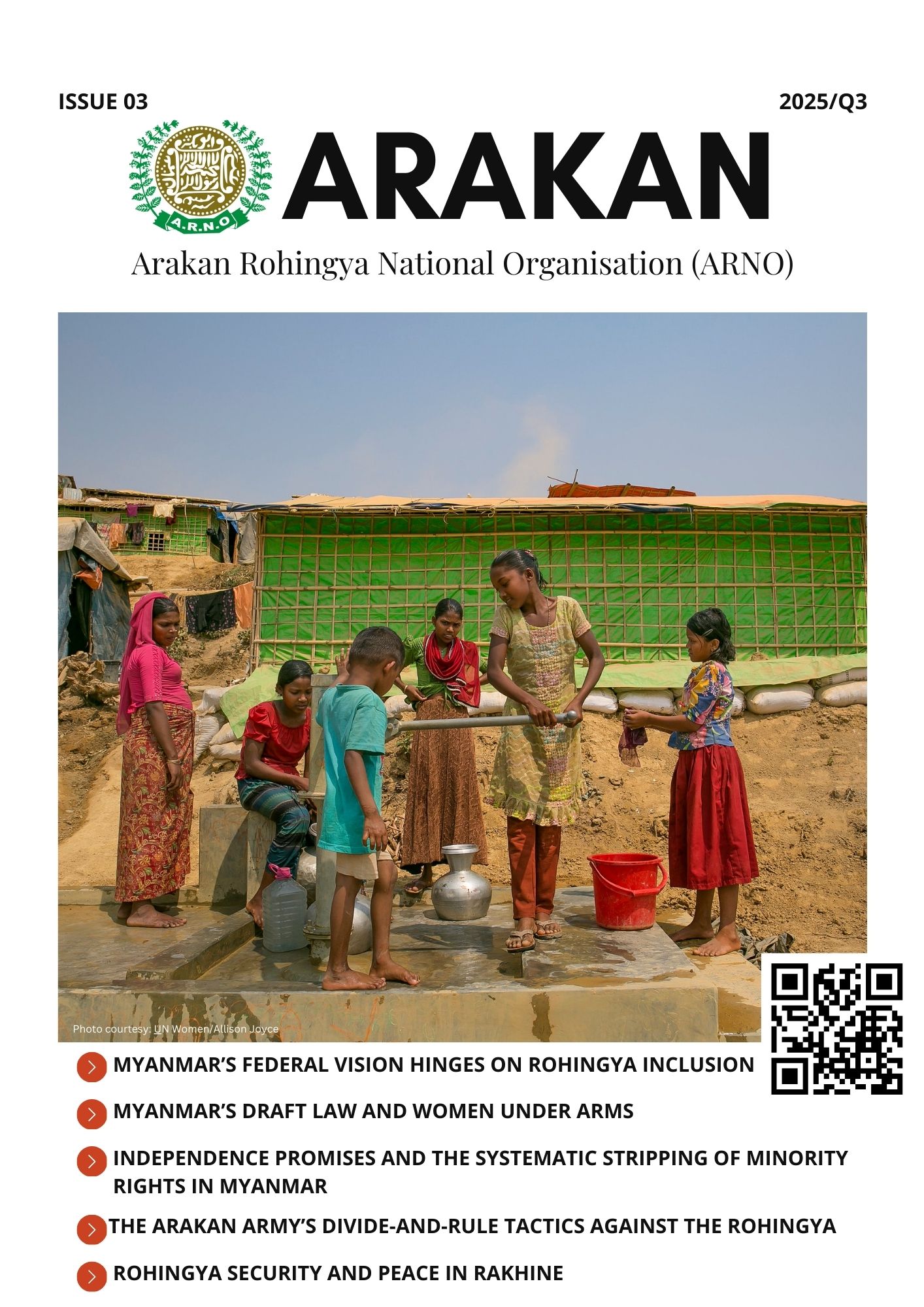
In This Issue:
- Editorial: Myanmar’s Federal Vision Hinges on Rohingya Inclusion
- Myanmar’s Draft Law and Women Under Arms
- Independence Promises and the Systematic Stripping of Minority Rights in Myanmar
- The Arakan Army’s Divide-and-Rule Tactics Against the Rohingya
- Rohingya Security and Peace in Rakhine
- IIMM Shares Evidence of Crimes Against Rohingya with International Courts
- Dhaka Declaration: Rohingya Speak with One Voice
- A Mosque Reopens in Maungdaw but What Does It Really Mean?
- Rohingya Women are Forced into Arakan Army Ranks
- On the 8th Anniversary of the Rohingya Genocide the Crisis Continues, the World Must Act
- ARNO Expresses Concern Over Crisis Group Report’s Misrepresentation of Rohingya Realities
- Eight Years On, Genocide Against Rohingya Persists
Latest News
THE ROHANG (ARAKAN)
By Mohamed Ashraf Alam
INTRODUCTION
The Rohingya Problem has of late become a matter of great concern to the government and to the people of Bangladesh as well as Muslim Ummah. Several lakhs of uprooted Rohingyas, men, women, and children, have been forced to leave their homeland Arakan and took shelter in Bangladesh. This is happened not once but twice, in 1978-79 and 1991-92; the problem is not yet over. This is a man-made problem, created by the ruling Burmese military junta. It is not due to the fault of the Rohingyas themselves and the reason is political and coercive policy of Burmese Junta. In Arakan, Rohingyas form a solid group, which is an eyesore to the Burmese government.1 The Rohingya have been settling in Arakan from long before the British occupation of the country. In fact the forefathers of Rohingyas had entered into Arakan from time immemorial. The Burmese ruling junta do not know, or pretend not to know that the Rohingyas have a long history, a language, a heritage, a culture and a tradition of their own that they had built up in Arakan by their long and historic settlements. In fact the Rohingya have been settling in Arakan for more than a thousand year.2 In order to know and understand the full context of the Rohingya problems, it is necessary to know the geographical location, the population, the historical background and culture, ethnic origin, chronology of activities of Rohingya nation.
Rohingya Health
WHO Definition of Health
'Health is a state of complete physical, mental, and social well-being not merely the absence of disease or infirmity.'
By the WHO definition, all the people of Arakan and of Burma are unhealthy and suffering from some kind of physical, mental or social disease. As you know Burma is being ruled by the brutal military Government, we all are suffering from fear, fright, flight and all kind persecutions.
To determine health status of our community, here we need to include health status measuring parameters such as crude death rate, life expectancy, maternal mortality rate, foetal mortality rate, number of Hospitals, etc. Due to the lack of records and unreliable statistics in our country, such parameters are unavailable.
Our Rohingya population is about 3.5 millions. Among them 2 millions live inside Burma mainly in the Arakan State and the rest are in Bangladesh, Pakistan, Middleast, Thailand, Malaysia etc in excile.
There are only one Specialist Hospital, two Township Hospitals, two Urban Health Centres and four Station Hospitals for our people in the Arakan state. Rural Health Centre and subcentre of health are located in each village without any facilities or supports and thus they can’t provide any health service. There are only 12 Rohingya doctors, 3 Rohingya dental surgeons for five decades. You can imagine our Rohingya health status by comparing population and available health facilities.
As our country is a developing and tropical country, infectious diseases, tropical diseases and malnutrition are common. The symptoms, complications and treatments mentioned below may or may not be typical and scientific. But these are common presentations, complications and actual treatments received in our community. The Preventive measures. are mentioned in the hope of that our people may practice individually or at the community level and may get benefits. However one should consult a professional doctor for thorough examination and medication.
EDUCATION FOR ROHINGYA
Currently we are doing lots of research in finding ways to educate our people. Student studied in Burma:The following link is an educational assisting site for those who have studied in Burma. http://geocities.com/mahawthahta/index.htmlStudent studied in Arab...
Rohingya Issue
The international community is well aware that we, the 3.5 million peace-loving Muslims of Arakan known as "Rohingya" have long been subjected to large-scale persecution, genocide, ethnic-cleansing, diabolical tyranny and extermination particularly by the...
Rohingya Food
Rice is the staple food grain of Arakan. The diet of Rohingya is simple rice, fish, vegetables, milk and chillies; meat is taken occasionally. The majority of Rohingyas eat fishes with fresh vegetables or potatoes. Dry fish also is not uncommon among Rohingyas. On all festive occasions cows, water buffaloes and goats are slaughtered for sale and distribution. They eat mutton, beef, and chicken after making `Halal' according to Islamic teaching. It was the tradition of the Rohingyas to honour their special guests by slaughtering a goat or more. If the host were poor he would honour his guest with a roasted chicken. Rohingyas do not eat tortoise, crab and pork.
The Political advancement of the Rohingya People
The Burmese military is bent on exterminating the Rohingya people to the last man by application of black laws and use of force. The Rohingya are today enlisted as one of the ten world populations in danger of extinction. These pre-planned extermination blueprint has seeded the revolutionary planet and forced the armless weak farmer in talking guns in place of plough.
FACTS ABOUT THE ROHINGYA MUSLIMS OF ARAKAN
By Nurul Islam
President
Arakan Rohingya National Organisation (ARNO)
Arakan, formerly called Rohang, lies on the north–western part of Burma with 360 miles coastal belt from the Bay of Bengal. It borders 167 miles with Bangladesh both by land and sea.
Rohingyas have been living in Arakan from time immemorial. They are a people with distinct culture and civilization of their own. They trace their ancestry to Arabs, Moors, Pathans, Moghuls, Bengalis and some Indo-Mongoloid people. Early Muslim settlements in Arakan date back to 7th century AD.
Our Appeal
The 2nd Rohingya National Council (RNC), the congress of the Arakan Rohingya National Organisation (ARNO), was held between 5-7 October 2000. It was attended by party delegates and representatives from home and abroad, including Ulema, elite and commanders of the...
Reports
No Results Found
The page you requested could not be found. Try refining your search, or use the navigation above to locate the post.
Rohingya Library
All ABOUT ROHINGYA
Press Release
No Results Found
The page you requested could not be found. Try refining your search, or use the navigation above to locate the post.
Experts Writing
No Results Found
The page you requested could not be found. Try refining your search, or use the navigation above to locate the post.
Rohingya History
No Results Found
The page you requested could not be found. Try refining your search, or use the navigation above to locate the post.
Rohingya Culture
No Results Found
The page you requested could not be found. Try refining your search, or use the navigation above to locate the post.
Rohingya Books
No Results Found
The page you requested could not be found. Try refining your search, or use the navigation above to locate the post.