
Press Releases
No Results Found
The page you requested could not be found. Try refining your search, or use the navigation above to locate the post.
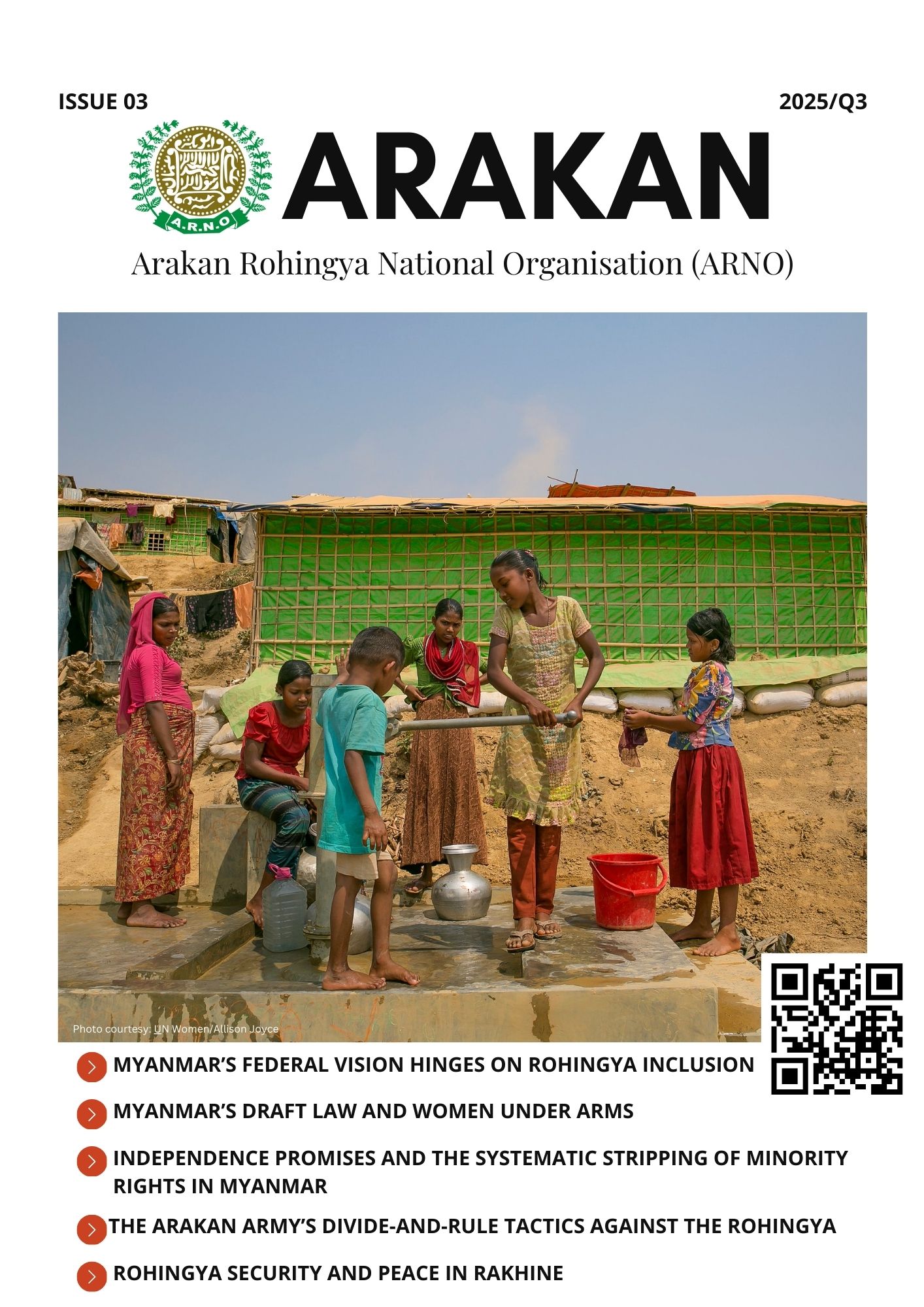
In This Issue:
- Editorial: Myanmar’s Federal Vision Hinges on Rohingya Inclusion
- Myanmar’s Draft Law and Women Under Arms
- Independence Promises and the Systematic Stripping of Minority Rights in Myanmar
- The Arakan Army’s Divide-and-Rule Tactics Against the Rohingya
- Rohingya Security and Peace in Rakhine
- IIMM Shares Evidence of Crimes Against Rohingya with International Courts
- Dhaka Declaration: Rohingya Speak with One Voice
- A Mosque Reopens in Maungdaw but What Does It Really Mean?
- Rohingya Women are Forced into Arakan Army Ranks
- On the 8th Anniversary of the Rohingya Genocide the Crisis Continues, the World Must Act
- ARNO Expresses Concern Over Crisis Group Report’s Misrepresentation of Rohingya Realities
- Eight Years On, Genocide Against Rohingya Persists
Latest News
Rohingya refugees’ desperate voyage for new home
Daniel Rook
KHAO LAK, Thailand (AFP) – Homeless, hungry and nine months pregnant, Nuru boarded a rickety boat filled with Rohingya asylum seekers fleeing a wave of deadly sectarian violence in western Myanmar.
Six days later she gave birth at sea, far from any hospitals or doctors.
Since Buddhist-Muslim tensions exploded last June in Myanmar’s Rakhine State, thousands of Rohingya boat people – including a growing number of women and children – have joined an exodus from the former junta-ruled country.
Nuru, 24, with her one month old baby, Muhammad Ayik, at a Thai government shelter in Khao lak, southern Thailand. Homeless, hungry and nine months pregnant, Nuru boarded a rickety boat filled with Rohingya asylum seekers fleeing a wave of deadly sectarian violence in western Myanmar
Those who arrived in neighbouring Thailand have been “helped on” by the Thai navy towards Malaysia further south or detained as illegal immigrants.
Hundreds are feared to have drowned along the way while others were rescued as far away as Sri Lanka.Phuket Boatpeople Vanish as Rohingya Lose Out to Lies and Propaganda
By Chutima Sidasathian and Alan Morison
News Analysis
PHUKET: No sign has been found of 14 Rohingya said to have landed on Phuket in a small group of boatpeople 10 days ago, among many now turning up around the entire Indian Ocean region.
Eight of the Rohingya were apprehended quickly on February 22 and are believed to be being held in the Phuket Immigration centre in Phuket City.
Of the other 14 who were reported to have been travelling with them, there has been no sign.
Another riddle concerns the location of the boat in which they are said to have arrived off Phuket’s popular Surin beach about 4am that day.Rohingya: Testing democracy in Myanmar
Jose Ramos-Horta and Prof. Muhammad Yunus
One of the fundamental challenges of a democracy is how to ensure the voice of the majority does not trample the essential rights of the minority. In the founding of the United States this was addressed by the Bill of Rights, some form of which is integrated into most democracies today.
Even as we applaud and rejoice in the new freedoms enjoyed by the Myanmar people, the country’s newly elected government must face this challenge as they evolve from autocratic rule into a democratic state. The tragedy of the Rohingya people, continuing to unfold in Rakhine State in the country’s western corner, on the border of Bangladesh, will be its proving ground.
The minority Muslim Rohingya continue to suffer unspeakable persecution, with more than 1,000 killed and hundreds of thousands displaced from their homes just in recent months, apparently with the complicity and protection of security forces.Remember the Rohingyas
Susan Metcalfe
The recently reported deaths at sea of nearly 100 Rohingya asylum seekers from Myanmar is the starkest reminder that Australia needs to step up its efforts to improve regional protection for asylum seekers and refugees. Without cohesive regional strategies to address the needs of fleeing asylum seekers, the body count will continue to grow, and we must all take some of the blame.
When more than 30 survivors were rescued from the sinking vessel off the coast of Sri Lanka, reportedly en route to Malaysia and Australia, stories emerged of bodies thrown overboard as people died from dehydration and starvation during weeks at sea.
When the Sri Lankan navy rescued another 138 people earlier this month, one person was found dead on board. In recent days, 121 Rohingya asylum seekers were rescued from a boat found drifting off the coast of Indonesia.Burma’s Rohingya Muslims: We Want Peace
By Nora Rowley
Physician and Human Rights Activist — USA
“We want peace,” were the Rohingya’s sentiments expressed to me again, as I recently revisited the Rakhine State in Myanmar/Burma, where a population of Muslims has been living for centuries.
Rohingyas face long-term misery in IDP camps
Report from European Commission Humanitarian Aid department
Sittwe, January 2013: Standing amongst heaps of woven bamboo panels and corrugated iron sheets, Abdul oversees more than 20 fellow Rohingya workers building over a dozen barrack-type shelters, each to house ten families displaced by the recent inter-communal fighting. “I used to work for a European NGO”, Abdul explains. ”So I am using my skills to work with contractors who have been tasked to build these shelters. This way my people have at least a roof over their heads”.
1,600 families have found shelter in this camp called “Say Tha Mar Gyi”, located about 8 km north-west of Sittwe, the Rakhine State capital. Here the construction of the barrack-type temporary shelters is just one of the activities underway. Latrines have been constructed, water bore-holes installed. Others, such as Abdul and his four children have found shelter with host families in Rohingya villages nearby, which survived the devastating communal violence between Rakhine and Rohingya communities.Wooden boat with 121 weak, hungry Rohingya found adrift off Indonesia’s Aceh province
Associated Press
BANDA ACEH, Indonesia – A wooden boat carrying 121 hungry, weak Rohingya has been found adrift off Indonesia’s northernmost province of Aceh.
A doctor at a hospital in Lhokseumawe says the boat had engine trouble and was discovered by fishermen about 25 kilometers (16 miles) off the coast.
The doctor, Herry Luthfi, said Wednesday that the group includes six women and two children under 5 years old. He says they are weak from hunger and dehydration.
The group’s destination was unclear.The Rohingya of Burma are on the edge of disaster. Why won’t the world act?
Emanuel Stoakes
The international community has been shamefully unresponsive to this crisis
The news last week that around a hundred refugees from Burma had slowly starved to death after 25 days at sea may have shocked those unfamiliar with the current state of affairs in Asia’s newest ostensible democracy. The harrowing reports more recently of mass rapes, involving torture, in the country’s western Rakhine state will likely have had a similar impact.
But to those who have been keeping up with the daily reports of intimidation, harassment and violence directed at ethnic minorities in Burma news of these latest horrors was heartbreaking, but unsurprising.
It was likewise grimly un-startling to read that in both cases the victims were from the most vulnerable of all ethnic groups in the country, the imperiled and desperate Rohingya minority.Shining light on the Rohingya
By Meghna Guhathakurta
“We Rohingyas are like orchids,” an 18-year-old Rohingya man called Shamsul once told me. “We are not able to grow any roots in the ground so we are left with only one way to stay alive and that is to cling on to others.”
– Emma Larkin, in the foreword to Exiled to Nowhere
Reports
No Results Found
The page you requested could not be found. Try refining your search, or use the navigation above to locate the post.
Rohingya Library
All ABOUT ROHINGYA
Press Release
No Results Found
The page you requested could not be found. Try refining your search, or use the navigation above to locate the post.
Experts Writing
No Results Found
The page you requested could not be found. Try refining your search, or use the navigation above to locate the post.
Rohingya History
No Results Found
The page you requested could not be found. Try refining your search, or use the navigation above to locate the post.
Rohingya Culture
No Results Found
The page you requested could not be found. Try refining your search, or use the navigation above to locate the post.
Rohingya Books
No Results Found
The page you requested could not be found. Try refining your search, or use the navigation above to locate the post.