Press Releases
No Results Found
The page you requested could not be found. Try refining your search, or use the navigation above to locate the post.
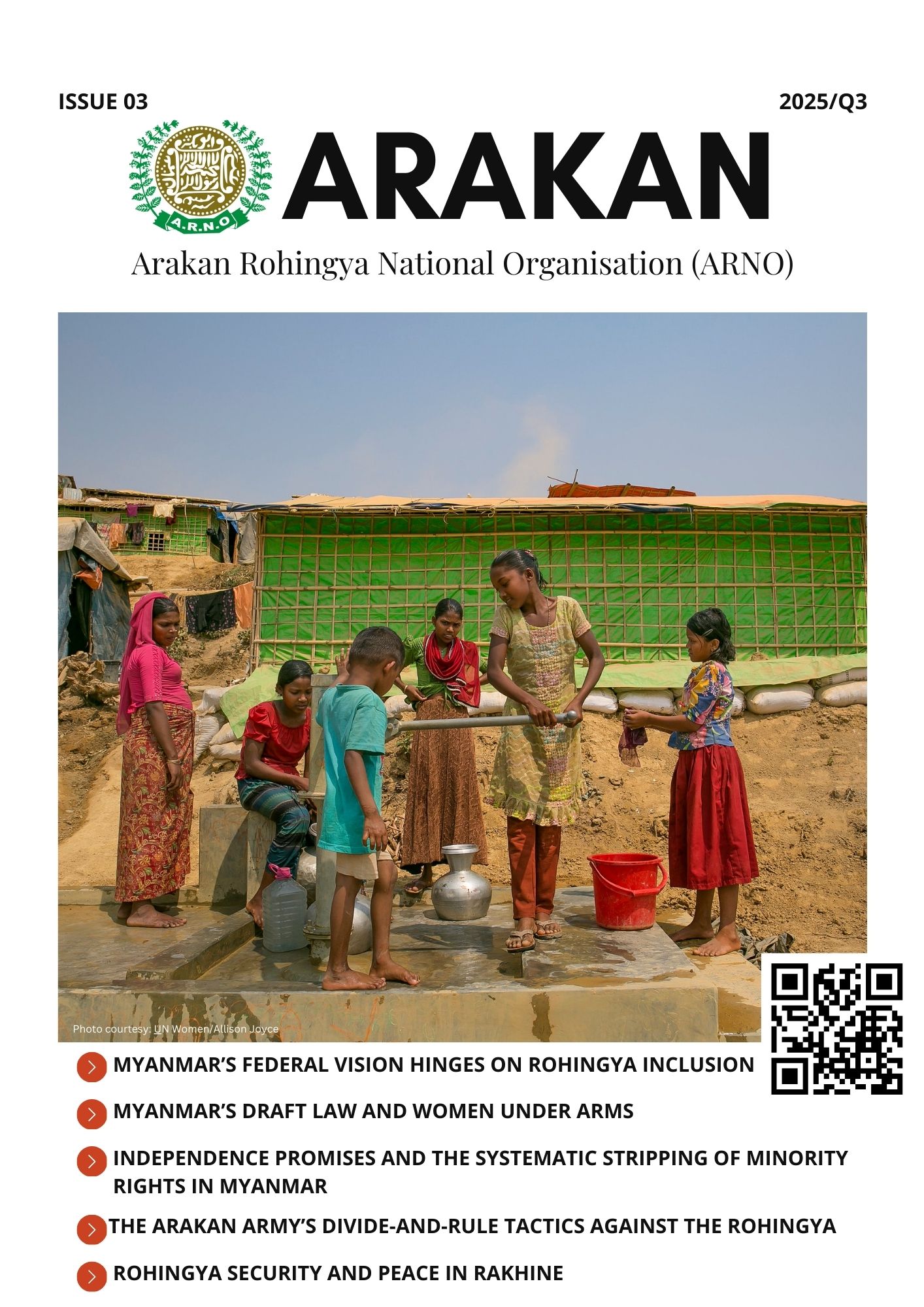
In This Issue:
- Editorial: Myanmar’s Federal Vision Hinges on Rohingya Inclusion
- Myanmar’s Draft Law and Women Under Arms
- Independence Promises and the Systematic Stripping of Minority Rights in Myanmar
- The Arakan Army’s Divide-and-Rule Tactics Against the Rohingya
- Rohingya Security and Peace in Rakhine
- IIMM Shares Evidence of Crimes Against Rohingya with International Courts
- Dhaka Declaration: Rohingya Speak with One Voice
- A Mosque Reopens in Maungdaw but What Does It Really Mean?
- Rohingya Women are Forced into Arakan Army Ranks
- On the 8th Anniversary of the Rohingya Genocide the Crisis Continues, the World Must Act
- ARNO Expresses Concern Over Crisis Group Report’s Misrepresentation of Rohingya Realities
- Eight Years On, Genocide Against Rohingya Persists
Latest News
Myanmar jails Buddhists over religious violence
AFP
YANGON (AFP) – Myanmar has sentenced more than 20 Buddhists to prison for their roles in religious riots in March, including a deadly attack on a Muslim boarding school, lawyers and police said Friday.
The convictions follow earlier concerns among rights groups that Muslims were bearing the brunt of the legal crackdown on suspects involved in the unrest which shook the central town of Meiktila.
The Buddhists were sentenced on Wednesday and Thursday on charges including murder, assault, theft, arson and inciting unrest, said a police official who did not want to be named.
According to state media, which did not specify the suspects’ religion, the sentences ranged from two years for minor offences such as theft to 10 years for murder, with some defendants handed several terms to be served separately.
Some of the charges related to the deaths of students at an Islamic school on the outskirts of Meiktila, according to Ba San, a lawyer who was at the court.
“We have to say that both Buddhists and Muslims have been sentenced if found guilty,” he told AFP.
More than a dozen Muslims have been convicted in relation to the violence, with a number receiving life imprisonment for murder.
In May seven Muslims were sentenced to between two and 28 years for their parts in the killing of a Buddhist monk during the unrest, which was apparently triggered by a quarrel in a Muslim-owned gold shop.Myanmar is ‘a long way’ from reconciliation: Carr
He says this follows as “night follows day” if legitimate grievances by the Rohingya community in Rakhine state aren’t dealt with.
Senator Carr has wrapped up a two-day visit to Myanmar where he has held talks with the government, opposition and community representatives in Naypyidaw.
Presenter: Karon Snowdon
Speaker: Bob Carr, Australia’s Foreign MinisterCARR: Well I put it to three or four ministers, to the Opposition leader, Aung San Suu Kyi, I put it as well to the Speaker of the Parliament, Shwe Marn, They know that Australia is deeply concerned about the position of the Rohingya, and about what appears to be systemic discrimination directed against them. They acknowledge that more work needs to be done in Rakhine State, where the Rohingya live.
SNOWDON: Did you get a sense that the government isn’t prepared to confront the anti-Rohingya elements, especially within the community of Buddhist monks in the country?
CARR: I would say, I’m not in a position to be that specific, but I would say, after speaking to representatives of two political parties, representing the non-Rohingya population, if we can put it that way in Rakhine State, that the problems are deep seated. There is a very strong prejudice directed against these people, how one would measure that, I’m not sure, but certainly the representatives of these groups I spoke to appeared hostile to the notion of Rohingya enjoying full citizenship and the rights that go with it and I found this somewhat, somewhat depressing.
SNOWDON: Very briefly, did you meet the Rohingya community representatives?
CARR: Yes, I did.
Myanmar jails two for riot murders
Myanmar has sentenced two Buddhist men to seven years in prison for murders during religious violence in March that left dozens of people dead, a local official said.
The defendants were convicted after separate trials at the district court in Meiktila for their part in deadly rioting in the town, which mainly targeted Muslims and sparked waves of religious unrest across the country.
Meiktila district chairman of Tin Maung Soe said one man, aged 24, was sentenced on June 28, becoming the first Buddhist known to be sentenced for a serious offence over the rioting, which left at least 44 people dead.
“He was found at the scene where some people were killed during the unrest in Meiktila. That is why he was charged with murder,” he told AFP.
He said the second suspect, aged 21, was handed sentences of seven years and one year with hard labour – to be served concurrently – on Friday for his part in the killings.Myanmar: Stepping up humanitarian response to persistent needs
08-07-2013 News Release 13/124
Geneva/Yangon (ICRC) – The International Committee of the Red Cross (ICRC) is expanding its efforts in Myanmar to improve prison conditions and help those suffering from armed conflict and other violence. Severe unrest in Rakhine state over the last year has disrupted several hundred thousand lives, leaving people without homes and livelihoods and severely reducing access to health care.
“Conflict and other violence in Myanmar have generated huge humanitarian needs,” said Alain Aeschlimann, the ICRC’s head of operations for East Asia, South-East Asia and the Pacific. “Hundreds of people have died or been injured, and many arrested. Thousands of homes have been destroyed, and communities struggle to obtain essential services.”
In an appeal issued to its donors, the ICRC is requesting 8.5 million Swiss francs (8.82 million US dollars) in additional funding, which brings the organization’s total budget for the country in 2013 to 15.6 million francs (16.4 million US dollars). The funds will mainly be used to assist those hardest hit by intercommunal violence and tensions in Rakhine state, western Myanmar. Following the resumption of its detention visits in January 2013, the ICRC is also stepping up its technical support to the authorities to improve detention conditions. Elsewhere, in conflict-affected Kachin and northern Shan states, where tens of thousands of civilians have reportedly been displaced, the organization is exploring ways to enhance health-care delivery.Myanmar Armed Forces discharge 42 children and young people
YANGON, 7 July 2013 – The United Nations Resident Coordinator and UNICEF welcomed the discharge today of 34 children and 8 young people by the Myanmar Armed Forces, or Tatmadaw, in line with the Government’s commitment to end the recruitment and use of children by the army in Myanmar.
The children and young people, who were recruited when they were children, were discharged to their families and friends in the presence of senior officials from the Tatmadaw, the Myanmar Ministries of Defence, Foreign Affairs, and Social Welfare, Relief, Rehabilitation and Resettlement.
The UN Resident Coordinator’s Office and UNICEF were also present as co-chairs of the UN task force charged with facilitating Myanmar’s implementation of UN Security Council Resolution 1612 in Myanmar together with representatives from other members of the task force.
“This discharge is the expression of a renewed commitment by the Government of Myanmar to ensuring UNSC 1612 is upheld as part of the current transition towards reform, good governance and inclusion. We expect the Tatmadaw will now be in a position to speed up the release of all children. We are very happy for the 42 children and their families today but we must accelerate efforts so that many more children benefit from release,” said UN Resident Coordinator Ashok Nigam.UN Calls for Release of All Burmese Child Soldiers
By SAW YAN NAING
The United Nations has welcomed Burma’s decision to free dozens of child soldiers and called for all remaining children to be released from the country’s armed forces.
The demobilization of 42 child soldiers on Sunday from Burma’s military, known as the Tatmadaw, was “encouraging,” says Unicef’s representative in Rangoon, Bertrand Bainvel, but not the last step.
“We are happy for the children who were released and their families,” he told The Irrawaddy on Tuesday. “We of course would like more and more children to benefit from such action. We want to see more and more children released from the ranks of the Tatmadaw in the future.”
There is a lack of official data on the number of remaining child soldiers in Burma, both in the government’s armed forces and rebel armed groups, but Bainvel estimates that about 520 children have been demobilized so far, as the country transitions from nearly half a century of military rule. Under the former junta, the Tatmadaw recruited children as young as 12 years old.Rohingyas in Hyderabad live in fear
Syed Mohammed, TNN
HYDERABAD: Though no stranger to harassment, hundreds of Rohingya refugees who have made the city their own, are apprehensive about policemen knocking on their doors once again in the wake of serial blasts in Bodh Gaya.
“The locals told us about the blasts. The police frequently ask us to produce documents and such harassment has become part of our lives,” said 28-year old Abdullah, who arrived in the city last year.
The Rohingya exodus began last June, a month before the onset of Ramzan, in the aftermath of ethnic violence between Rakhine Buddhists and Rohingya Muslims in Myanmar.
Linking the attack on the Mahabodhi temple to Rohingyas was unfair, Abdullah, who goes by one name, said. “We were unaware of the attack as most of us cannot read, write or even speak local languages. We are first concerned about earning money to buy food and get refugee status,” he said.
While many Rohingyas settled in Delhi and Pune, a substantial number chose Hyderabad as their new home. They believed the city, on account of its substantial Muslim population, would welcome them with arms wide open. But little did they think about police questionings and needless interrogation each time a Hindu shrine or a Buddhist structure comes under attack.
Hyderabad-based Confederation of Voluntary Organisations (Cova), an NGO at the forefront of Rohingya rehabilitation says 1,200 asylum seekers have registered with them so far and many more are likely to come.Something Burmese Patriots Should Consider
By MIN NAING THU
The sectarian conflict between Muslims and Buddhists, which started last year in western Burma’s Arakan State, is becoming increasingly complicated. In order to analyze why it is taking place and how it has spread to other cities and areas quickly, I want to go back to the beginning of the problem.
The inter-communal riots broke out following an alleged rape and killing of Thida Htwe, an Arakanese woman from Kyauknimaw Village in Arakan’s Ramree Township in late May 2012, by three Muslim youth. Many people have heard about this case but few know about its details. A closer study reveals however, that there is something unusual about the alleged crime and the way that information about it was spread.
The supposed rape took place in a place on Ramree Island, a very remote area off the Burmese coast, yet it was reported online in Facebook posts the very next day. The news spread rapidly on the social network and quickly inflamed lingering tensions between Muslims and Buddhists in Arakan State.
The victim’s photo and related instigation, as everybody knows, provoked a Buddhist mob attack on a bus of Muslim pilgrims visiting Taunggup a few days later. Then violence rapidly spread through different parts the state and beyond.
Similar incidents occurred in the region in the past, but never before did it spark large-scale inter-communal violence. Unlike in previous cases, an unpleasant photo of the victim was spread through print and online social media, stirring up strong emotions among Buddhist nationalist readers.‘TIME’ Magazine Was Wrong: Burmese Nationalist Monk Wirathu Stands Vindicated – OpEd
By Shenali Waduge
There is a common thread that runs through the histories of Buddhist countries; they have all been the victim at one time or the other of aggressive incursions made by people of Abrahamic faiths i.e. Christians or Muslims. This process has not ended. It still continues unabated and with greater ferocity. When prominence is given to “reconciliation” their incursions have yet to be apologized or compensated.
One thousand years ago Buddhist Asia ranged from Afghanistan to Japan. Today countries such as Afghanistan, Pakistan, Bangladesh, Maldives, Malaysia, Indonesia, Philippines, and South Korea are no longer identified as Buddhist. Several other traditional Theravada Buddhist countries such as Myanmar, Thailand and Sri Lanka today find themselves besieged by forces more powerful and predatory than their slender resources can match. Their appeal to the call for Buddhist nationalism is a last resort to preserve their heritage, religion and country to ensure history is not repeated.
The situation in Myanmar (Burma) must be understood in such context. The latest issue of ‘Time’ Magazine (July 1, 2013) has got it all wrong when it accused the leading defenders of the Buddhist heritage of Burma as terrorist. Western colonial countries and their Islamic acolytes have never admired Buddhist heroes or those who resisted European or Islamic conquests of Buddhist lands.Reports
BURMA’S PARLIAMENT:A TOOL FOR INSTITUTIONALIZED OPPRESSION
· Despite the regime’s claim that an elected legislature was a crucial step towards the emergence of its “discipline-flourishing democracy,” the Parliament is turning out to be the regime’s key tool for institutionalizing oppression.
· The pro-regime Union Solidarity and Development Party (USDP)-dominated Parliament refuses to repeal the draconian laws that provided the basis for the imprisonment of several thousand political prisoners in recent years.
Rohingya Library
All ABOUT ROHINGYA
Press Release
No Results Found
The page you requested could not be found. Try refining your search, or use the navigation above to locate the post.
Experts Writing
No Results Found
The page you requested could not be found. Try refining your search, or use the navigation above to locate the post.
Rohingya History
No Results Found
The page you requested could not be found. Try refining your search, or use the navigation above to locate the post.
Rohingya Culture
No Results Found
The page you requested could not be found. Try refining your search, or use the navigation above to locate the post.
Rohingya Books
No Results Found
The page you requested could not be found. Try refining your search, or use the navigation above to locate the post.