Press Releases
No Results Found
The page you requested could not be found. Try refining your search, or use the navigation above to locate the post.
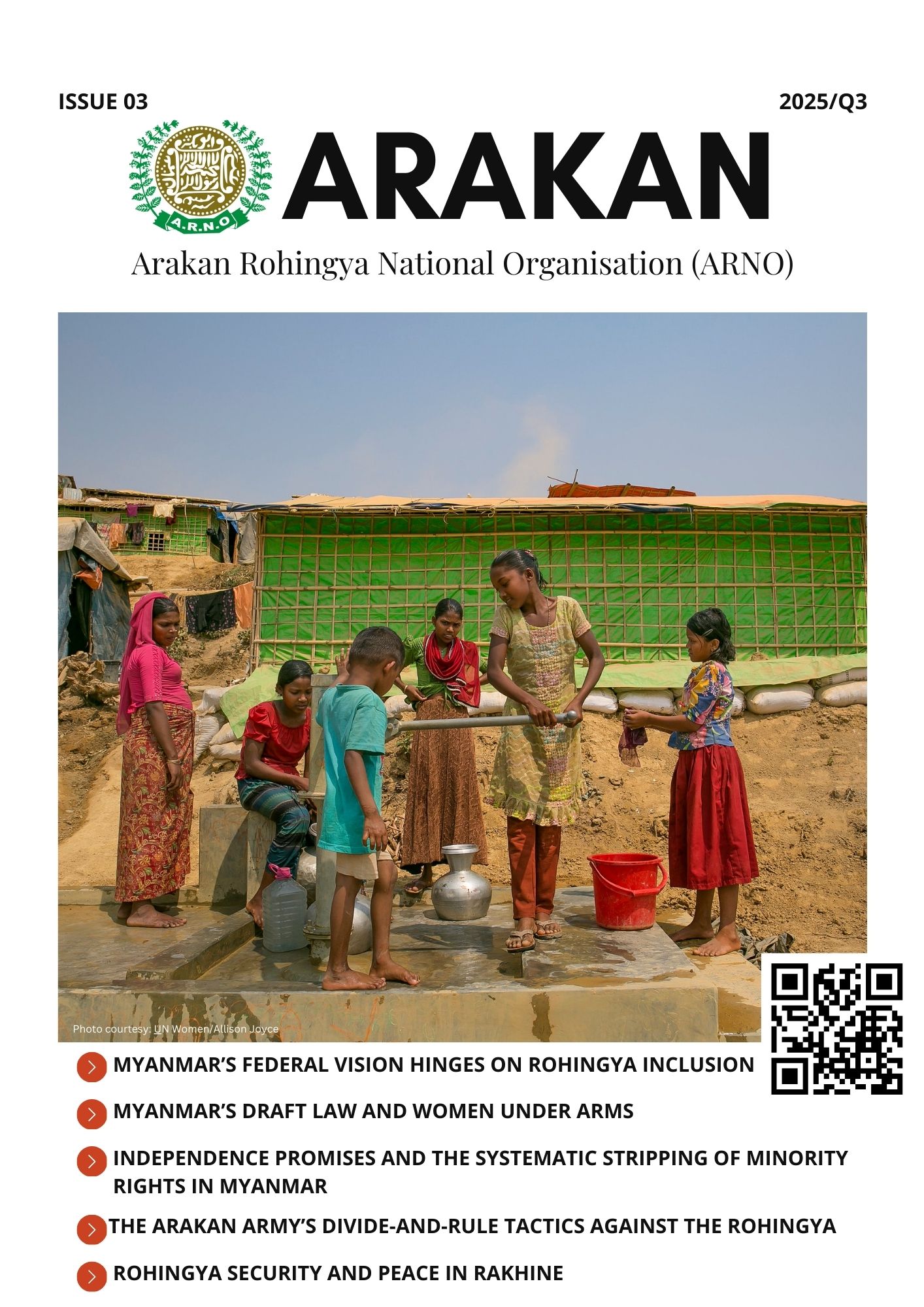
In This Issue:
- Editorial: Myanmar’s Federal Vision Hinges on Rohingya Inclusion
- Myanmar’s Draft Law and Women Under Arms
- Independence Promises and the Systematic Stripping of Minority Rights in Myanmar
- The Arakan Army’s Divide-and-Rule Tactics Against the Rohingya
- Rohingya Security and Peace in Rakhine
- IIMM Shares Evidence of Crimes Against Rohingya with International Courts
- Dhaka Declaration: Rohingya Speak with One Voice
- A Mosque Reopens in Maungdaw but What Does It Really Mean?
- Rohingya Women are Forced into Arakan Army Ranks
- On the 8th Anniversary of the Rohingya Genocide the Crisis Continues, the World Must Act
- ARNO Expresses Concern Over Crisis Group Report’s Misrepresentation of Rohingya Realities
- Eight Years On, Genocide Against Rohingya Persists
Latest News
Why Burma could become another Rwanda
Ahamed Jarmal
guardian.co.uk,
Burma is ethnically cleansing the Rohingya people. When David Cameron meets the Burmese president tomorrow he must call for it to stop
After the genocide that tore apart a nation and killed 800,000 in Rwanda, the world said never again. But nearly 20 years later, we find ourselves on the brink of another campaign of destruction against an entire people. Yet once again it is being greeted with silence.
In Burma, ethnic cleansing is happening. We have seen more human rights violations and attacks on Rohingya minorities in the past two years than in the last 20. Organised in monasteries and on Facebook, a wave of hate is being broadcast against the Muslim Rohingya community in Burma and a new apartheid system is being introduced.
My family regularly get called “dogs” or worse when they walk down the street. The government continues to deny us citizenship, telling us this isn’t our home. We can’t marry the people we love and are told we’re only allowed to have two children per family. We can’t travel from one village to another without permission. No other minority in the world faces such extreme and vicious treatment. We are being treated as criminals simply because we exist.Letter from America: Why Buddhism Declined? – Part 2
By Dr. Habib Siddiqui
When history is twisted, humanity loses. No country epitomizes this notion to the hilt better than Buddhist-majority Myanmar where history is twisted not only to deny human rights but also to justify genocidal campaigns against religious minorities.
There is no historical record of Buddha ever visiting any part of Arakan and Burma, and yet the popular Mon and Myanmar oral tradition, including the chronicle Sasanavamsa, and the belief of the Arakanese Rakhines suggest that the Buddha visited their king and left behind an image of himself for them to worship. The Sasanavamsa mentions several visits of the Buddha to Myanmar and one other important event: the arrival of the hair relics in Ukkala (Yangon) soon after the Buddha’s enlightenment.
Modern historiography, of course, dismisses these stories as fabrications made out of national pride, as the Myanmar had not even arrived in the region at the time of the Buddha.
Myanmar is a country of many nations: many races and ethnicities – Shan, Kachin, Kayah, Kayin, Rohingya, Rakhine, Mon, Karen, Chinese, Indians – and many religions, e.g., Buddhism, Islam, Christianity, Sikhism and Hinduism. To insist that Myanmar is the country of the majority Bamar (Burman) – who practice Theravada Buddhism – at the exclusion of the minority religious communities would be a deliberate attempt that ignores and denies the history of the ‘other’ peoples to this landmass.Myanmar signs peace treaty with Wa rebels
The government of Myanmar has signed a peace deal with the rebels of the ethnic Wa guerrilla group, according to state media.
The Kyemon Daily newspaper said on Saturday that the agreement was reached on Friday between the rebels and a government peace delegation that travelled to the remote Wa region in Shan state, which borders China.
The five-point agreement includes a clause calling for regular meetings between the two sides whenever military issues arise.
The United Wa State Army (UWSA) also made a commitment not to secede from Myanmar, also known as Burma, in the document.
In addition, Myanmar’s military and the UWSA agreed to return to positions they occupied before a recent standoff.
The Wa, who have a fighting force numbering as many as 30,000, reached a peace agreement with the central government in 1989, but recently tensions escalated after the Myanmar military surrounded Wa territory.Press Release: Prime Minister David Cameron Should Press President Thein Sein to Stop Rohingya Ethnic Cleansing
14/07/2013
Joint Statement by Arakan Rohingya National Organisation (ARNO) and Burmese Rohingya Organisation UK (BROUK)
After decades of persecution, state sponsored deadly violence against the Rohingya and Kaman Muslims was carried out in Arakan in June and October 2012 that resulted in the killing of many thousands people, massive rape and large scale destruction of villages, homes and properties and displacement of about 150,000 Muslims. In addition the evidences of mass grave have been uncovered by the creditable human rights groups.
Myanmar: Invest at your own risk
By Lisa Misol, Special to CNN
Editor’s note: Lisa Misol is a senior researcher on business and human rights with Human Rights Watch in New York. The views expressed are her own.
Emerging from diplomatic isolation and Western economic sanctions, Myanmar wants to be the “it” destination for foreign investors.
Last month, foreign business leaders flocked to the capital, Naypyidaw, for the World Economic Forum on East Asia, a regional version of the powerhouse gathering. Major global brands have been enticed by Myanmar’s largely untapped potential, and the momentum is still picking up: General Electric, the first American company to sign a deal after U.S. sanctions were lifted last July, formally launched its Myanmar office in late May. On June 4, Coca-Cola opened its first bottling plant in the country in 60 years, on the heels of Carlsberg and Heineken. Then, on June 27, Myanmar’s government awarded highly anticipated licenses to extend cell phone and Internet service to telecommunications firms from Norway and Qatar.
More investors are lining up. In the petroleum sector, dozens of companies from around the world reportedly bid on 30 sought-after offshore oil and natural gas fields last month. A shortlist has not been announced, but prominent American, Asian, and European oil firms are seen as likely contenders. At least 20 more fields are to be offered next.Jakarta Pressing Burma on Rohingya Legal Rights
Ron Corben
BANGKOK — Indonesia is pressing Burma’s government to grant legal status to the country’s Muslim Rohingya. As more Rohingya seek asylum in Indonesia and elsewhere abroad, Ron Corben reports from Bangkok that Indonesia’s Foreign Minister Marty Natalegawa says Burma needs to take action to end inter-communal violence.
Indonesia’s Foreign Minister, Marty Natalegawa, says Burma has to press on with democratic reforms and recognize the legal rights of hundreds of thousands of stateless Muslim Rohingya.
Burma – also known as Myanmar – has been wracked by sectarian bloodshed over the past year that has led to more than 200 deaths and displaced tens of thousands. Fighting began in communities with large numbers of ethnic Rohingya, who are denied citizenship in Burma.
Natalegawa, speaking to reporters in Bangkok Wednesday, says Indonesia is “encouraging” Burma to grant legal recognition to the Rohingya as an initial step to ease tensions.
“There is the issue of the status issue, which on the one hand is political as well as legal, which we are now encouraging the government of Myanmar to address in a fundamental way so that the Rohingya can obtain the kind of status and legal rights similar and akin to the rest of their countrymen,” said Natalegawa.TIME: ‘Burmese bin Laden’ — The face of Buddhist terror
By Eko Armunanto
A Buddhist monk Wirathu calling himself Burmese bin Laden was recently labeled on the cover of Time magazine as the Face of Buddhist Terror. He is the Buddhist monk accused of stoking religious hatred across Burma, said NBC News contributor MacGregor.Briefly describing what’s in its printed version entitled “The Face of Buddhist Terror,” TIME says “His face as still and serene as a statue’s, the Buddhist monk who has taken the title ‘the Burmese bin Laden’ begins his sermon. Hundreds of worshippers sit before him, palms pressed together, sweat trickling silently down their sticky backs. On cue, the crowd chants with the man in burgundy robes, the mantras drifting through the sultry air of a temple in Mandalay, Burma’s second biggest city after Rangoon. It seems a peaceful scene, but Wirathu’s message crackles with hate: Now is not the time for calm.”
Sparked widespread protests across the country, Burmese government banned the TIME magazine portraying Ashin Wirathu as the Burmese bin Laden. Circa said Wirathu leads the radical Buddhist group 969 which says that the country’s Muslim minority threatens national security and racial purity. Violence against Muslims has resulted in 250 deaths and displaced 150,000 people in the past year.
Muslims Petition UN on Burma Persecution
OnIslam & News Agencies
CAIRO – Muslim states have petitioned UN Secretary-General Ban Ki-moon to take an action against Burma over ongoing attacks against Muslims in the Buddhist-majority country.
“Myanmar (Burma) is having a honeymoon with the world,” Saudi Arabia’s UN ambassador Abdullah al-Mouallemi was quoted as saying by Agence France-Presse (AFP) on Thursday, July 11.
“The only problem is that that honeymoon is being built on the bodies of the Muslim victims in that country.”
The Saudi ambassador and other delegates of members of the umbrella Organization of Islamic Cooperation (OIC) met Ban on Wednesday to demand more action by the United Nations over attacks against Muslims in Burma.
Burmese Muslims have been facing repeated attacks by the Buddhist majority in recent months.
Scores of Muslims have been killed and thousands displaced in bouts of religious violence in western Burma last year.UK MP wants Rohingya solution
Syed Nahas Pasha
UK Shadow Minister for International Development, Rushanara Ali, MP, has urged the British government to apply pressure on the Burmese authorities to address the humanitarian crisis in Burma and put human rights at the heart of their reforms process.
Burmese president Thein Sein will soon begin his official tour of the United Kingdom, Northern Ireland and France, it was announced yesterday.
Ali expressed worries about the humanitarian crisis in Burma’s Rakhine State and the human rights abuses against the Rohingya, a Muslim community, and other minorities in Burma.
She acknowledged the progress the Burmese government had made towards political and economic reforms since President Thein Sein took office. But, she said, the international community should not ignore the considerable work the Burmese government still needs to do.
Rushanara Ali, MP, who recently visited Burma, said, “Since inter-communal violence first broke out last year, Rohingya Muslims have been forced into segregated settlements and their movements have been restricted, stripping them of their livelihoods and rendering them reliant on aid. Displaced people are living in constant fear of violence, abuse and harassment both from the security services and from fears of a further attack from sections of the Rakhine population.
She urged the UK and the international community to press the President to make real commitments to bring those responsible for inter-communal violence to justice.
“There are growing concerns regarding the disparity between the President’s words and his actions as Burma’s human rights record remains poor,” she said. “There can be no impunity for those committing human rights abuses in Burma.”Reports
Burma: Rohingya Refugees And Thailand’s ‘Push-Back’ – Analysis
By Panchali Saikia
The Rohingya refugee crisis is not a new phenomenon, and it has now grabbed the attention of the international media for all the wrong reasons. The Rohingyas, in large numbers, are now trying to escape to Malaysia via the sea route through Thailand, but are being denied entry by Thai authorities and forcibly pushed back. Earlier this year around 91 persons believed to be Rohingyas were rescued near Andaman Island by the Indian Navy and around 129 by the Indonesian Navy in Aceh. The Rohingyas have been sheltered by Bangladesh for nearly three decades. What is the reason for their escape to Malaysia? Why is Thailand forcibly pushing them back to sea? Thailand has provided shelter to hundreds and thousands of other displaced people from Myanmar, why is then expelling the Rohingyas?
Rohingya Library
All ABOUT ROHINGYA
Press Release
No Results Found
The page you requested could not be found. Try refining your search, or use the navigation above to locate the post.
Experts Writing
No Results Found
The page you requested could not be found. Try refining your search, or use the navigation above to locate the post.
Rohingya History
No Results Found
The page you requested could not be found. Try refining your search, or use the navigation above to locate the post.
Rohingya Culture
No Results Found
The page you requested could not be found. Try refining your search, or use the navigation above to locate the post.
Rohingya Books
No Results Found
The page you requested could not be found. Try refining your search, or use the navigation above to locate the post.