
Press Releases
No Results Found
The page you requested could not be found. Try refining your search, or use the navigation above to locate the post.
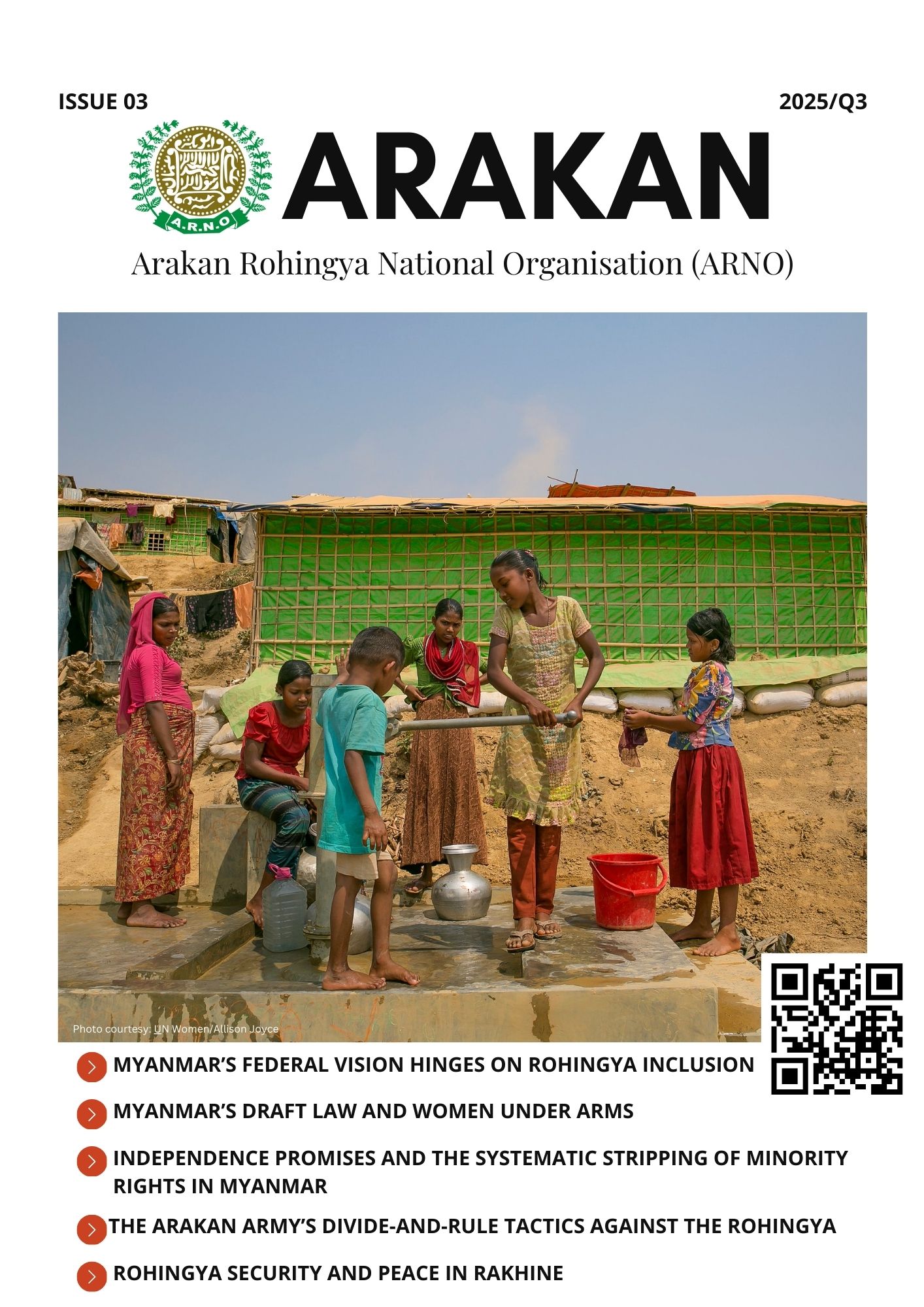
In This Issue:
- Editorial: Myanmar’s Federal Vision Hinges on Rohingya Inclusion
- Myanmar’s Draft Law and Women Under Arms
- Independence Promises and the Systematic Stripping of Minority Rights in Myanmar
- The Arakan Army’s Divide-and-Rule Tactics Against the Rohingya
- Rohingya Security and Peace in Rakhine
- IIMM Shares Evidence of Crimes Against Rohingya with International Courts
- Dhaka Declaration: Rohingya Speak with One Voice
- A Mosque Reopens in Maungdaw but What Does It Really Mean?
- Rohingya Women are Forced into Arakan Army Ranks
- On the 8th Anniversary of the Rohingya Genocide the Crisis Continues, the World Must Act
- ARNO Expresses Concern Over Crisis Group Report’s Misrepresentation of Rohingya Realities
- Eight Years On, Genocide Against Rohingya Persists
Latest News
EU urges Myanmar to resolve Rohingya minority issue
KUNA
BRUSSELS – The EU Foreign Affairs Council, Monday, welcomed and endorsed a “Comprehensive Framework” consisting of priorities for the European Union’s policy and support in the next three years to Myanmar/Burma.“This Framework sets forth EU’s goals and priorities geared towards building a lasting partnership and promoting closer engagement with the country as a whole,” said a council statement.
The EU encouraged the immediate end of hostilities across the country, including in the Kachin State. It called for the early launch of inclusive political negotiations aimed at a lasting peace settlement.
The EU urged the government to pursue and implement durable solutions to the underlying causes of the tensions in the Rakhine State.
“These should include addressing the welfare needs and the status of the Rohingya minority. Most urgent is the need to deal with human rights and humanitarian needs of the displaced population,” it noted.
US engagement in Myanmar should be backed by pragmatism
By Paula J. Dobriansky
In some respects, the challenges to democracy-building in Myanmar are greater than those in Egypt and Turkey
After five decades of brutal military rule, hopeful signs have emerged in Myanmar. The military has partially opened up the political system and released Aung San Suu Kyi, the iconic leader of the country’s democracy movement, after 15 years of house arrest. Since September 2011, ceasefire agreements have been signed with 11 ethnic groups, contributing to national political reconciliation.
Yet, ending the military’s dominance is just one challenge. The daunting task is constructing a durable democracy in a country with limited civil society traditions and a complex ethnic and religious mix. The difficulty is underscored by the experiences of other multi-ethnic and multi-religious societies that have struggled to build democratic institutions after overthrowing a military dictatorship, with democratically elected leaders disregarding the rule of law.No justice for Muslims massacred by Myanmar Buddhists
by Todd Pitman
AP
MEIKHTILA, MYANMAR – Their bones are scattered in blackened patches of earth across a hillside overlooking the wrecked Islamic boarding school they once called home.
Smashed fragments of skulls rest atop the dirt. A shattered jaw cradles half a set of teeth. And among the remains lie the sharpened bamboo staves attackers used to beat dozens of people to the ground before drowning their still-twitching bodies in gasoline and burning them alive.
The mobs that March morning were Buddhists enraged by the killing of a monk. The victims were Muslims who had nothing to do with it — students and teachers from a prestigious Islamic school in central Myanmar who were so close to being saved.
In the last hours of their lives, police had been dispatched to rescue them from a burning compound surrounded by swarms of angry men. And when they emerged cowering, hands atop their heads, they only had to make it to four police trucks waiting on the road above.
It wasn’t far to go — just one hill.Myanmar leader says cleansing claims are ‘smear campaign’
AFP
Myanmar President denies Human Rights Watch report accusing the country of fueling ‘a campaign of ethnic cleansing’ against Rohingya Muslims
Myanmar President Thein Sein denied on Friday accusations of ethnic cleansing against Rohingya Muslims, saying the claims were part of a “smear campaign” against his government.
On a visit to Paris, Sein told France 24 television that his government was not guilty of the charges.
“Outside elements are just exaggerating, fabricating news, there is no ethnic cleansing whatsoever,” he said.
“This is a smear campaign against the government. What happened in Rakhine was not ethnic cleansing.”
In April, Human Rights Watch accused Myanmar of “a campaign of ethnic cleansing” against the Rohingya.Myanmar parliament, govt peace making group meets on peace process
Xinhua
Myanmar’s government and parliamentary peace making group met at the Myanmar Peace Center here Sunday to discuss the current peace process.
The rare joint meeting was participated by Speaker of House of Representatives (Lower House) USwe Mann, Chairperson of the House’s Committee for Rule of Law and Tranquility Aung San Suu Kyi and Vice Chairman of the Central Peace Making Work Committee U Aung Min, who is also Minister at the Presidential Office.
It was also the first time for opposition leader Aung San Suu Kyi to be involved in the government’s peace talks.
Special Adviser to the Myanmar Peace Center U Hla Maung Shwe quoted Aung San Suu Kyi as saying that Myanmar should make use of the international assistance extended to the peace process, and attach importance to the judicial and rule of law affairs in the peace building.Mataf bridge ready to ease Umrah for disabled, elderly
JEDDAH: P.K. ABDUL GHAFOUR
The new mataf bridge around the Holy Kaaba opens for pilgrims this week. Only disabled and elderly pilgrims will be allowed to use the circular bridge that can hold 7,000 wheelchair-borne pilgrims per hour.“Since the bridge would be set apart for weak, infirm and disabled pilgrims, the movement of able-bodied pilgrims below on the ground floor will become easier as that area will be free from wheelchairs that used to clutter in an already crowded area,” said the Haj Ministry’s spokesman Hatim Qadi.
Authorities have stepped up preparations to receive millions of pilgrims in the second half of Ramadan as they come from across the world to perform Umrah and attend special prayers at the Grand Mosque in Makkah.
Dhaka wants Rohingyas living in KSA to forego Bangla passports
DHAKA: ARAB NEWS
Hundreds of thousands of the Rohingya Muslims from Myanmar living in the Kingdom, who had received Bangladeshi passports in 1978-79 to flee Buddhist persecution in the Burmese state of Arkan, have been urged by Dhaka to forgo Bangladeshi passports.Bangladeshi Expatriates’ Welfare Minister Mosharraf Hossain recently said around 500,000 Rohingyas are living in Saudi Arabia with Bangladeshi passports.
Dhaka and Islamabad had come forward to rescue the persecuted Rohingyas.
“Pakistan gave them passports with a BM (Burmese Muslims) code without having recognized them as Pakistani nationals.
But the military ruler (in Bangladesh) issued them passports with Bangladeshi nationality. That was not only a historic mistake, but an offense too,” Bangladeshi Foreign Minister Dipu Moni told Dhaka Tribune. “Passports cannot be issued to any foreign national. We are trying to correct the mistake the then government of the country made,” she said.
St. Paul: For Karen immigrants, a ‘big family reunion’ this weekend
Aye Mya Phyu feared for her children as she ran from Burmese soldiers and into the jungle.
She moved from various safe zones along the Myanmar and Thailand border and eventually made her way to the United States. Now a St. Paul resident, she has been helping other immigrants escape the violence of their homeland and adjust to life here.
“It was like finding my freedom,” Phyu recalled thinking when she first arrived to St. Paul. “Now we have no more fear.”
The steady trickle of Karen, an ethnic minority from southern Myanmar, has been immigrating since 2000. More than 7,500 now live in Minnesota, according to the Karen Organization of Minnesota. It is now home to more Karen (pronounced “kuh-REHN”) than any other state, with large populations in St. Paul, Roseville and Maplewood.Letter from America: Why Buddhism Declined? – Part 3
By Dr. Habib Siddiqui
Popular myths circulated and believed amongst many Buddhists about the decline of Buddhism in South Asia or the Indian subcontinent are so bizarre that they are more often than not diametrically opposed to the historical facts. Those myths, unfortunately, define and justify the current genocidal campaigns against non-Buddhists in Buddhist-majority countries. This series of articles aims at an objective study on the causes of such decline.
Against popular Buddhist narrative of history, before Islam came to South Asia Buddhism has already been marginalized by powerful Hindus. Even in Bengal, which is only a short distance from where Siddhartha Gautama Buddha was born, Hindu Brahmins/leaders/rulers were able to reclaim their control over the people.Reports
Burma’s Rohingya: The Human Story
{youtube}8vntGrS2nvY{/youtube}
Rohingya Library
All ABOUT ROHINGYA
Press Release
No Results Found
The page you requested could not be found. Try refining your search, or use the navigation above to locate the post.
Experts Writing
No Results Found
The page you requested could not be found. Try refining your search, or use the navigation above to locate the post.
Rohingya History
No Results Found
The page you requested could not be found. Try refining your search, or use the navigation above to locate the post.
Rohingya Culture
No Results Found
The page you requested could not be found. Try refining your search, or use the navigation above to locate the post.
Rohingya Books
No Results Found
The page you requested could not be found. Try refining your search, or use the navigation above to locate the post.