Press Releases
No Results Found
The page you requested could not be found. Try refining your search, or use the navigation above to locate the post.
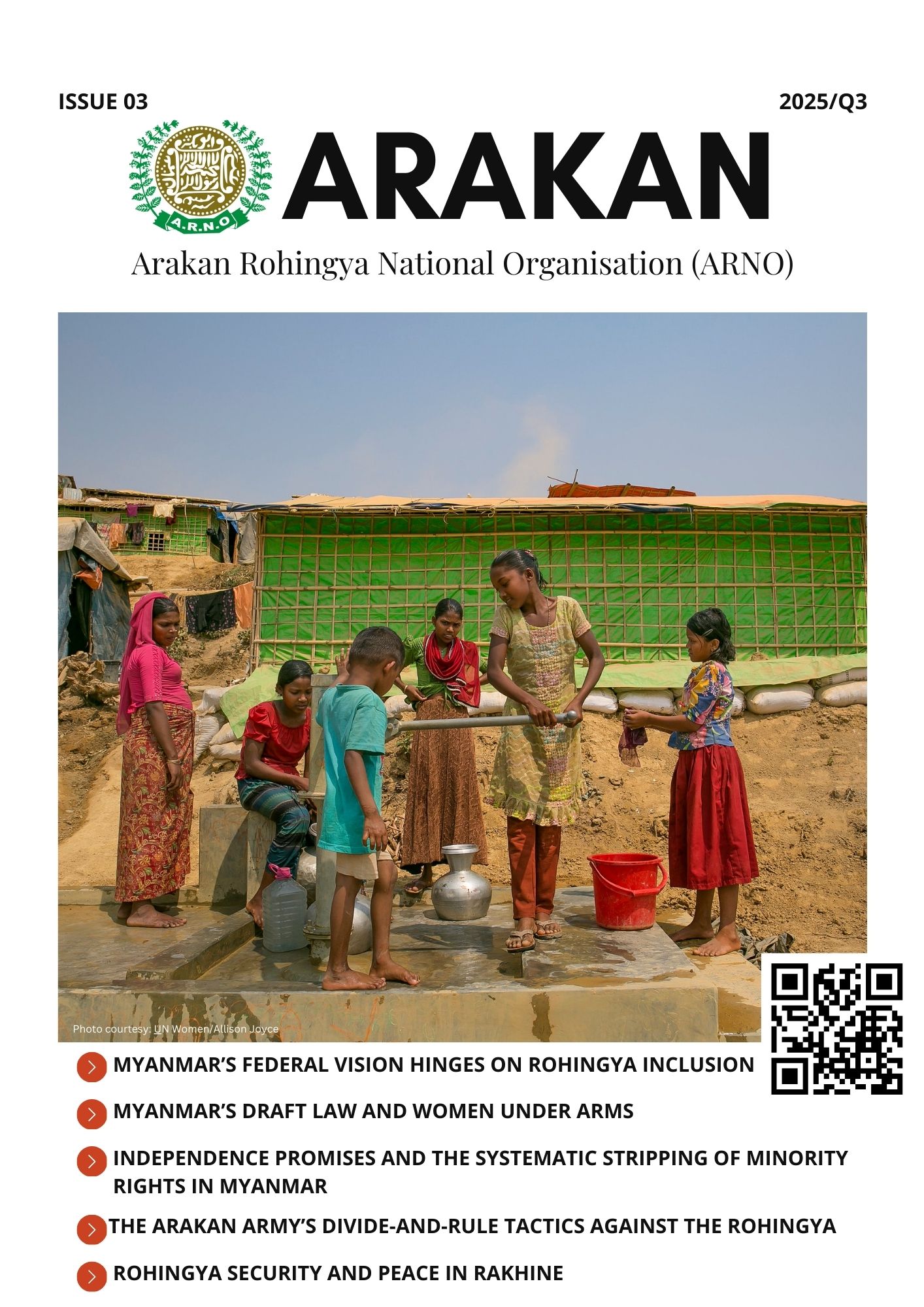
In This Issue:
- Editorial: Myanmar’s Federal Vision Hinges on Rohingya Inclusion
- Myanmar’s Draft Law and Women Under Arms
- Independence Promises and the Systematic Stripping of Minority Rights in Myanmar
- The Arakan Army’s Divide-and-Rule Tactics Against the Rohingya
- Rohingya Security and Peace in Rakhine
- IIMM Shares Evidence of Crimes Against Rohingya with International Courts
- Dhaka Declaration: Rohingya Speak with One Voice
- A Mosque Reopens in Maungdaw but What Does It Really Mean?
- Rohingya Women are Forced into Arakan Army Ranks
- On the 8th Anniversary of the Rohingya Genocide the Crisis Continues, the World Must Act
- ARNO Expresses Concern Over Crisis Group Report’s Misrepresentation of Rohingya Realities
- Eight Years On, Genocide Against Rohingya Persists
Latest News
Burma: The Despots and the Laughter
Jonathan Mirsky
It’s hard to get a handle on Burma. When Aung San Suu Kyi was recently here in London, feted on every hand, she was asked about the persecution of the Rohingya, the Burmese Muslims. She replied, “I’m not sure they’re Burmese.” The Dalai Lama, who has declared that Burma’s Buddhist monks must stop beating up Muslims, was here at the same time and wished to meet her. She agreed, but only if there was no publicity. She had been advised about this by the office of Prime Minister David Cameron, who had earlier been denied contact with Beijing for having met with the Dalai Lama for forty minutes. I know about the meeting with Aung San Suu Kyi only because the Dalai Lama told me during his London visit.Are Extremist Buddhists in Burma attacking Helpless Muslims? (Walton)
(Author title: “Matthew Walton: A Primer on the Roots of Buddhist/Muslim Conflict in Myanmar, and A Way Forward” )
Matthew J. Walton writes at ISLAMiCommentary
Recently Myanmar has been in the news for more than just its surprising political reforms and nascent transition from military rule. Violent attacks—mostly by Buddhists against Muslims—have occurred in cities across the country and an insistent and vocal new movement called 969 (named after the holy attributes of the Buddha, his teachings, and the community of monks) has galvanized Buddhist nationalism. Monks have been some of the loudest voices in this movement, calling for laws that discriminate against Muslims and even threatening politicians who refuse to support them. Many casual observers know that Myanmar is a predominantly Buddhist country, but relatively little is known about the Burmese Muslim community. In this essay I will give a brief introduction to the Muslim community in Myanmar, explain the roots and dynamics of the current religious conflict, and consider some of the challenges facing Muslims in the country.Are Extremist Buddhists in Burma attacking Helpless Muslims? (Walton)
(Author title: “Matthew Walton: A Primer on the Roots of Buddhist/Muslim Conflict in Myanmar, and A Way Forward” )
Matthew J. Walton writes at ISLAMiCommentary
Recently Myanmar has been in the news for more than just its surprising political reforms and nascent transition from military rule. Violent attacks—mostly by Buddhists against Muslims—have occurred in cities across the country and an insistent and vocal new movement called 969 (named after the holy attributes of the Buddha, his teachings, and the community of monks) has galvanized Buddhist nationalism. Monks have been some of the loudest voices in this movement, calling for laws that discriminate against Muslims and even threatening politicians who refuse to support them. Many casual observers know that Myanmar is a predominantly Buddhist country, but relatively little is known about the Burmese Muslim community. In this essay I will give a brief introduction to the Muslim community in Myanmar, explain the roots and dynamics of the current religious conflict, and consider some of the challenges facing Muslims in the country.Burmese regime plot for resumption of killing Muslims by monks
By Koraunghfee
After five decades when Myanmar dictatorial regime has to step down unwillingly due to international pressings, in 2008, the notorious dictator Junta Than Shwe held referendum throughout the state with his adopted Hitlerite fiddles senior talented militaristic officials to rule the state militaristically as quasicivilian regime.
To implement perpetually the ancient pre-planned propaganda against Muslims, in particular, Rohingya across the country that were unwillingly postponed amidst ongoing democracy transition from military transition, the histrionic military backed president Thein Sein triggered continual riots with some Buddhist ultra-nationalists, as well as in corporation, with Buddhist radical monks and racialistic Buddhist youth clubs. Then, the president empowered the Rakhine terrorists with all the necessary tasks conspiring with the current Rakhine Nationalities Development Party (RNDP) not only to massacre the Rohingya in a vast momentum but also to strip of Rohingya rights during ongoing democracy.Myanmar: bottom-up, not top-down
By Stephen Hindes
Constant armed clashes in Myanmar, despite continuing peace talks, and rising tensions between Buddhists and Muslims underscore the fragility of President Thein Sein’s attempts to bring democracy to the country.
For the international community to effectively negotiate these complicated and deeply embedded tensions and effect positive developments it must leverage the knowledge and talent of
Myanmar’s established network of local nongovernmental organizations (NGOs).
Afghan, Myanmar women win Magsaysay award
Agence France-Presse
Afghanistan’s first and only female provincial governor and an aid worker from Myanmar’s Kachin minority are among the winners of this year’s prestigious Ramon Magsaysay awards, the award foundation said Wednesday.
The Manila-based Ramon Magsaysay Award Foundation, named after a popular Filipino president who was killed in a plane crash, was established in 1957 to honour people or groups who change communities in Asia for the better.
Both Habiba Sarabi, governor of the Afghan province of Bamyan, and Myanmar aid worker Lahpai Seng Raw did not allow their minority origins to stop them from empowering other people, said the foundation.
The 55-year-old member of the minority Hazara group was recognised for promoting education and women’s rights despite working in an impoverished and war-torn environment, it said.Taking the pulse on Burmese repatriation
BANGKOK, 25 July 2013 (IRIN) – A recent pilot survey of thousands of Burmese refugees in Thailand could play a key role in gauging possible large-scale repatriation.
“The whole idea is to get a sense of refugee sentiment about their future beyond living in the camps,” Vivian Tan, regional spokesperson for the UN Refugee Agency (UNHCR), told IRIN in Bangkok.
According to The Border Consortium (TBC), an umbrella group of NGOs working along the 1,800km Thai-Myanmar border, there are close to 130,000 refugees from various ethnic groups in nine Thai government-run camps in the area, many of whom have been in the country for decades.
More than 6,000 households at the Mae La camp near the Thai border town of Mae Sot took part in the survey, which was launched in mid-June and concluded in mid-July.Remembering Martyrs’ Day and Mon resistance
Burmese both across the country and abroad celebrated the Martyrs’ Day on July 19. The anniversary marks one of the most important days in Burma’s history. Sixty-six years ago the country’s father of independence Gen. Aung San was assassinated along with his eight cabinet members. It’s a day that no Burmese can ever forget because it became a pivotal point in the country’s history.
The assassination that followed country’s independence from Britain was followed by civil wars that continue until this present-day. The root of these problems could be characterized in the failure of Burman leaders to implement the Panglong Agreement inked by Gen. Aung San and various ethnic leaders. If the agreement had come to fruition it would have given the ethnic groups federalism.
Likewise, July 19 is also memorable day in the history of the Mon national revolution. Mon armed resistance began in the middle of 1948 just after the country received independence. The Mon People Front (MPF) resisted for 10 years before exchanging their arms for peace under the former Prime Minster U Nu government on July 19, 1958.Peace For A Price
Reports
Address by Mr. Ahmet Davutoğlu, Minister of Foreign Affairs of Turkey at the 67th United Nations General Assembly
28 September 2012, New York
Mr. President,
Mr. Secretary-General,
Excellencies,
Distinguished Delegates,
At the outset, I wish to congratulate my dear friend His Excellency Vuk Jeremic for his election as the President of the 67th General Assembly.
I believe with his able leadership he will contribute greatly to work of the General Assembly.
Rohingya Library
All ABOUT ROHINGYA
Press Release
No Results Found
The page you requested could not be found. Try refining your search, or use the navigation above to locate the post.
Experts Writing
No Results Found
The page you requested could not be found. Try refining your search, or use the navigation above to locate the post.
Rohingya History
No Results Found
The page you requested could not be found. Try refining your search, or use the navigation above to locate the post.
Rohingya Culture
No Results Found
The page you requested could not be found. Try refining your search, or use the navigation above to locate the post.
Rohingya Books
No Results Found
The page you requested could not be found. Try refining your search, or use the navigation above to locate the post.