
Press Releases
No Results Found
The page you requested could not be found. Try refining your search, or use the navigation above to locate the post.
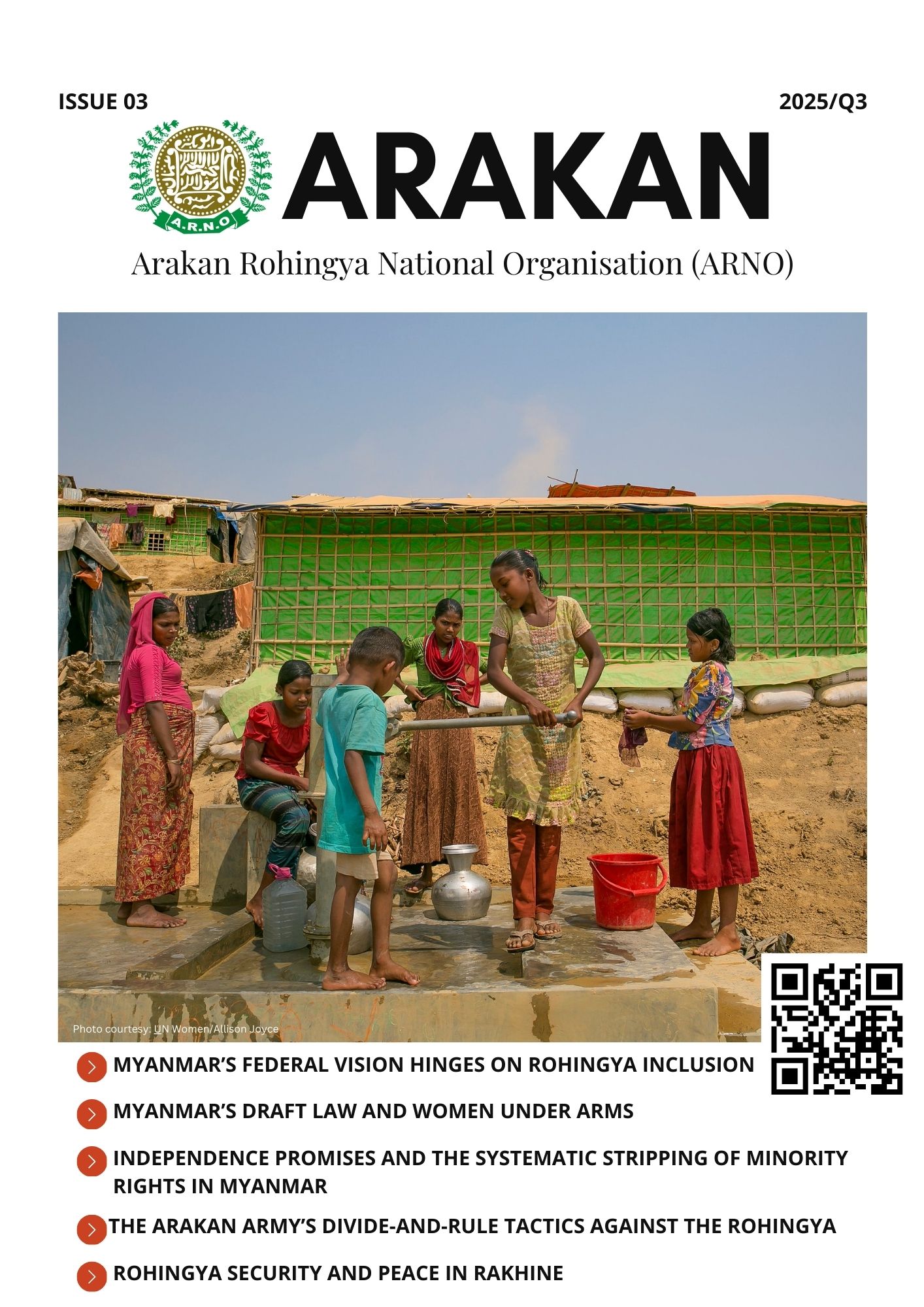
In This Issue:
- Editorial: Myanmar’s Federal Vision Hinges on Rohingya Inclusion
- Myanmar’s Draft Law and Women Under Arms
- Independence Promises and the Systematic Stripping of Minority Rights in Myanmar
- The Arakan Army’s Divide-and-Rule Tactics Against the Rohingya
- Rohingya Security and Peace in Rakhine
- IIMM Shares Evidence of Crimes Against Rohingya with International Courts
- Dhaka Declaration: Rohingya Speak with One Voice
- A Mosque Reopens in Maungdaw but What Does It Really Mean?
- Rohingya Women are Forced into Arakan Army Ranks
- On the 8th Anniversary of the Rohingya Genocide the Crisis Continues, the World Must Act
- ARNO Expresses Concern Over Crisis Group Report’s Misrepresentation of Rohingya Realities
- Eight Years On, Genocide Against Rohingya Persists
Latest News
Nickel City Smiler – film review
Author: Victoria Jack and Saw Blacktown
Thousands of Karen refugees on the Thai Burma border have been resettled in the United States. Nickel City Smiler follows the ups and downs of Smiler Greely, a refugee, as he battles to carve out a new life for his family in Buffalo, New York State. Victoria Jack and Saw Blacktown review the documentary for Karen News.
After escaping horrific violence at the hands of the Burmese junta and spending 20 years in Mae La refugee camp, Karen refugee Smiler Greely and his family have been resettled to one of America’s poorest cities.
The streets on the west side of Buffalo are lined with houses that have been boarded up and abandoned, while gangs, drugs and crime are rife.
Against this backdrop, the filmmakers of Nickel City Smiler pose a question that drives the documentary: how are Smiler, his wife Ma Dee and their three children – one of many Burmese families sent to live on the dark side of Buffalo – supposed to make a new life for themselves in such a hopeless place?Video shows Burmese police standing by as Buddhists attack Muslims
Kate Hodal
Footage emerges of police failing to prevent violence in Burma as EU prepares to lift all sanctions permanently
Video footage has emerged showing Burmese police standing by as Buddhist mobs wielding sticks and swords attack Muslims in Meikhtila – where last month more than 40 people were killed and 12,000 displaced – on the same day that the EU is expected to permanently lift all sanctions against the country.
The footage, apparently shot by police officers, shows Buddhist crowds looting and ransacking a Muslim jewellery shop, cheering when Muslims are attacked, and setting fire to mosques and houses. Later, a man who has been set alight and is believed to be Muslim can be seen lying in the road, surrounded by a crowd of people. “Pour water on him,” a man in the crowd commands. “Let him die,” shouts another. “No water for him.”
Both Buddhist monks and police can be seen through much of the footage – the monks often taking part in the violence, the police watching immobile as it progresses.Myanmar reform progress troubles London
LONDON, July 31 (UPI) — A British delegate said Wednesday before leaving for Myanmar he was “very concerned” about the status of reforms under way in the country.
Speaker of the House of Commons John Bercow leads a delegation of British lawmakers this week to Myanmar, known also as Burma. He said he’s expected to meet pro-democracy leader Aung San Suu Kyi, policy makers and members of civil society during his visit.
Myanmar President Thein Sein, a former military commander, was feted in London by British Prime Minister David Cameron mid-July. Cameron congratulated the leader for democratic reforms embraced since 2010 general elections, though he expressed concern about violence targeting the minority Muslim community in the coastal state of Rakhine.Myanmar’s government still watching activists, despite promising freedom
Associated Press
MANDALAY, Myanmar // It’s been two years since Myanmar’s new government promised its people a more open way of life, but still they come, plainclothes state intelligence officers asking where former student activist Mya Aye is and when he’ll be back.
Politicians, journalists, writers, diplomats, too, find themselves being watched: Men on motorcycles tailing closely. The occasional phone call. The same, familiar faces at crowded street cafes.
“It’s not as bad as it used to be,” said Mya Aye, who devotes much of his time today campaigning for citizens’ rights, “but it’s really annoying. They act like we’re criminals, harassing us, our families. It’s disrespectful and intimidating. It shouldn’t be this way anymore.”Myanmar News: Abuse of Rohingya Muslims is a Red Flag That’s Reminiscent of Rwanda
Andrew Friedman
The rapid political reform of Myanmar’s leadership has earned the country a reputation as a “development darling,” a country quickly changing from an international pariah to a beacon of opportunity. But, as we have seen with historical “darlings,” the positive steps of reform (and the media coverage of them) can often hide widespread human rights violations.
In 2009, the Obama administration began a policy of engagement with Myanmar, which led to a string of diplomatic successes. Since then, the country’s military junta has retired, elections were held for the first time in 20 years, and a number of political prisoners, including Nobel laureate Aung San Suu Kyi, were released. The United States greeted such changes by systematically easing economic sanctions, and increasing diplomatic contact. In late 2011, then Secretary of State Hillary Clinton visited Myanmar, becoming the first senior American official to visit the country in more than 50 years. Clinton’s trip was followed by an unprecedented November 2012 visit by President Barack Obama, making him the first sitting U.S. president to enter the formerly reclusive Southeast Asian state.Myanmar Activist Jailed 10 years For Anti-Mine Protest
from Radio Free Asia
A court in central Myanmar has sentenced an activist to a decade in prison for “threatening national security” after he led a protest against a controversial China-backed copper mine which led to clashes with authorities, according to a fellow campaigner.
Judge Kaythi Hlaing of the Shwebo city court handed Aung Soe, an activist with Myanmar’s People’s Support Network, the 10-year sentence on Monday after convicting him on eight charges linked to the violence on April 25, Moe Moe, also of the activist’s group, told RFA’s Myanmar Service.
The group had backed hundreds of farmers protesting the alleged seizure of their land by Wan Bao Company, which runs the copper mine near Mount Letpadaung in northern Burma’s Sagaing division.Ethnic conference joined by Wa, allies
Shan Herald Agency for News
The Peace and Democratic Front (PDF) alliance, formed by the ex-Communist Party of Burma (CPB) forces in the wake of its overthrow in 1989, will be joining today’s conference held in Chiangmai by the Ulnited Nationalities Federal Council (UNFC), according to sources from the Thai-Burmese border.
It includes representatives from the Panghsang-based United Wa State Party/United Wa State Army (UWSP/UWSA), Moongla-based National Democratic Alliance Army (NDAA) and the Myanmar National Democratic Alliance Army (MNDAA) that has been in exile out of its Kokang base since 2009.
Xiao Hsarm Khun speaking at the Shan-Kayah Trust Building for Peace conference in Lashio, Shan State, on 22 March 2013 (Photo: Kawli Media)Petition letter given to Canadian government by Rohingya organization
Kaladan Press
The Canadian Burmese Rohingya Organization of Canada (CBRO) met with the Canadian government to talk about the ethnic cleansing of Rohingya in Arakan state. Nur Hashim, CBRO chairperson, and other members met with Honorable Stephen Woodworth, Canadian Member of Parliament, in Kitchener, Ontario.
During the meeting there were discussions about the Burma’s 1982 citizenship and the recent killings and destruction of Rohingya properties during last year’s sectarian violence.
Woodworth promised CBRO that he would bring present these issues once the Canadian parliament re-opens.Myanmar’s internal spy network lives on
Todd Pitman
MANDALAY (Myanmar): It’s been two years since Myanmar’s new government promised its people a more open way of life, but still they come, plainclothes state intelligence officers asking where former student activist Mya Aye is and when he’ll be back.
Politicians, journalists, writers, diplomats, too, find themselves being watched: Men on motorcycles tailing closely. The occasional phone call. The same, familiar faces at crowded street cafes.
“It’s not as bad as it used to be,” said Mya Aye, who devotes much of his time today campaigning for citizens’ rights, “but it’s really annoying. They act like we’re criminals, harassing us, our families. It’s disrespectful and intimidating. It shouldn’t be this way anymore.”Reports
Thousand Homes Torched in Fresh Arakan Strife
RANGOON—Fresh clashes between Muslims and Buddhists have broken out in volatile western Burma, leaving at least two people dead and more than a thousand homes burned to the ground, authorities said on Tuesday.
Rohingya Library
All ABOUT ROHINGYA
Press Release
No Results Found
The page you requested could not be found. Try refining your search, or use the navigation above to locate the post.
Experts Writing
No Results Found
The page you requested could not be found. Try refining your search, or use the navigation above to locate the post.
Rohingya History
No Results Found
The page you requested could not be found. Try refining your search, or use the navigation above to locate the post.
Rohingya Culture
No Results Found
The page you requested could not be found. Try refining your search, or use the navigation above to locate the post.
Rohingya Books
No Results Found
The page you requested could not be found. Try refining your search, or use the navigation above to locate the post.