Press Releases
No Results Found
The page you requested could not be found. Try refining your search, or use the navigation above to locate the post.
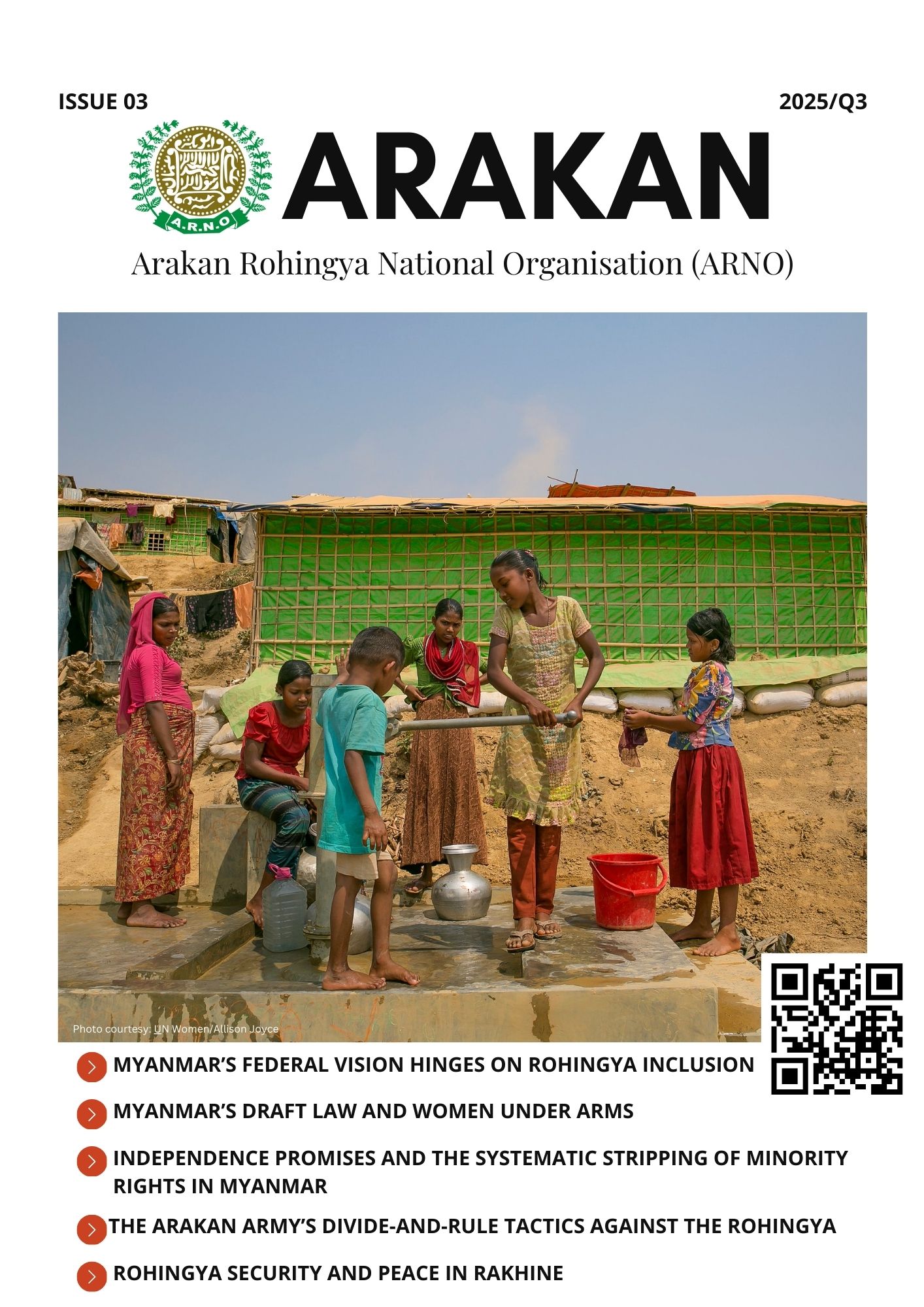
In This Issue:
- Editorial: Myanmar’s Federal Vision Hinges on Rohingya Inclusion
- Myanmar’s Draft Law and Women Under Arms
- Independence Promises and the Systematic Stripping of Minority Rights in Myanmar
- The Arakan Army’s Divide-and-Rule Tactics Against the Rohingya
- Rohingya Security and Peace in Rakhine
- IIMM Shares Evidence of Crimes Against Rohingya with International Courts
- Dhaka Declaration: Rohingya Speak with One Voice
- A Mosque Reopens in Maungdaw but What Does It Really Mean?
- Rohingya Women are Forced into Arakan Army Ranks
- On the 8th Anniversary of the Rohingya Genocide the Crisis Continues, the World Must Act
- ARNO Expresses Concern Over Crisis Group Report’s Misrepresentation of Rohingya Realities
- Eight Years On, Genocide Against Rohingya Persists
Latest News
Ethnicity, Ideologies, and the unraveling of modern Burma
By Justin Whitaker
This Thursday marks the 25th anniversary of the 8/8/88 uprising in Burma, which will hopefully spur some much needed discussion about the situation in the country (officially renamed Myanmar by the military junta in 1989, but still called Burma by those who deny the legitimacy of that government).
Three articles have already popped up in the last few days that deserve mention, if only for the varying perspectives in them – all dealing specifically with recent Buddhist-Muslim violence. The three perspectives are, roughly, that of a Conservative Christian, a journalist, and an academic.Burmese government and Army running counter to each other? : Thai security
BNI
Thai border security has been wondering whether the Burmese government led by U Thein Sein and the armed forces led by Senior General Min Aung Hlaing are at cross purposes when it comes to the ongoing peace process, according to senior security sources.
The question emerged following the Regional level Border Committee (RBC) meeting in Cha-am held last week, which coincided with the United Nationalities Federal Council (UNFC) organized conference in Chiangmai, 29-31 August.Burma: Justice for 1988 Massacres
HRW
On 25th Anniversary of Crackdown, Accountability, Rule of Law Remain Elusive
The mass killings 25 years ago in Burma are an unaddressed open wound that challenges the government’s rhetoric of reform. The government should shed itself of 50 years of denial about military abuses by showing that it stands with the Burmese people and not with the killers of the past.
Brad Adams, Asia director
Myanmar: Ethno-Resource conflict in Rakhine state?
by Asma Masood
The Rohingya issue is seen less as a clash between religions and more of an ethnic and economic problem within Myanmar’s rapidly developing economy, according to a Times of India report. The report also quotes an investment consultant that there is competition for land and resources after the country opened its economy. He adds that the fundamental cause of tension in Rakhine is largely economic.
How have economic factors contributing to conflict in Rakhine state evolved? What impact does international aid have on the conflict? Can the conflict be bracketed as merely economic?Capital Insecurity in Myanmar
by Maung Zarni
Over the past three years, change in Myanmar has transpired at a dizzying pace. A cursory look at the turn of events, ranging from the release of hundreds of political prisoners to restored diplomatic relations with the West, indicates on the surface a new national direction after decades of dictatorship. But what is Myanmar transitioning toward and how best to understand the changes?
Thomas Carothers and Larry Diamond, two of the world’s leading authorities on democratization, reached more or less the same conclusion after recent visits to the country: that Naypyidaw’s goals, definition and modus operandi of ‘democracy’ are at odds with the essence of a truly representative government.Non-Violent Extremism: The Case Of Wirathu In Myanmar – Analysis
By RSIS
The controversial Buddhist monk Wirathu, putative leader of the Buddhist fundamentalist 969 movement in Myanmar, has fuelled Buddhist-Muslim violence in the past year. Liberal responses to let the marketplace of ideas drown his extremist rhetoric are unlikely to suffice.Myanmar’s punks take on its ‘fascist’ Buddhist monks
Associated Press
YANGON // Punk rockers draw double-takes as they dart through traffic, but it is not just the pink hair, leather jackets or skull tattoos that make these 20-somethings rebels. It is their willingness to speak out against Buddhist monks instigating violence against Muslims while others in Myanmar are silent.
“If they were real monks, I’d be quiet, but they aren’t,” said Kyaw Kyaw, lead singer of Rebel Riot, as his drummer knocks out the beat for a new song slamming religious hypocrisy and an anti-Muslim movement known as 969. “They are nationalists, fascists. No one wants to hear it, but it’s true.”Myanmar: Will The Peace Process Materialise? – Analysis
By C. S. Kuppuswamy
Introduction
In his address at the Chatham House, UK on 15 July 2013, President Thein Sein categorically asserted that the armed fighting in Myanmar since 1948 will end soon.
“There are issues of autonomy and self determination of power sharing and resource sharing, of cultural rights and language policy, of protection against discrimination and security sector-reform” said President Thein while enumerating the complexities of the peace process.
With President Thein Sein’s assertions at the Chatham House and the government’s announcement to hold an all-inclusive ethnic conference shortly hopefully culminating in a nation wide ceasefire, there is fervour and enthusiasm and expectation of that long elusive sustainable peace in Myanmar.Myanmar Has a Clandestine Nuclear Weapons Program. And Nobody Cares.
Author: Dan Joyner
This just came to my attention today. Read this story at Pro Publica, about some very important and alarming work that friend of ACL, and real life former weapons inspector Robert Kelley, has done on what he has concluded is a clandestine nuclear weapons program in Myanmar. Now, I am not in any way a technical guy. But I’ve gotten to know Bob, and he’s both the most qualified person to evaluate a nuclear weapons program, and the most independent, objective, and reserved technical person, that I know. So hearing Bob say this about Myanmar:
“I state this very clearly and strongly, this is a clandestine nuclear program”
makes me say, it’s time to listen up, people.Reports
SPECIAL REPORT – Witnesses tell of organized killings of Myanmar Muslims
By Jason Szep and Andrew R.C. Marshall
PAIK THAY, Myanmar (Reuters) – On a hot Sunday night in a remote Myanmar village, Tun Naing punched his wife and unleashed hell.
She wanted rice for their three children. He said they couldn’t afford it. Apartheid-like restrictions had prevented Muslims like Tun Naing from working for Buddhists here in Rakhine State along Myanmar’s western border, costing the 38-year-old metalworker his job.
Rohingya Library
All ABOUT ROHINGYA
Press Release
No Results Found
The page you requested could not be found. Try refining your search, or use the navigation above to locate the post.
Experts Writing
No Results Found
The page you requested could not be found. Try refining your search, or use the navigation above to locate the post.
Rohingya History
No Results Found
The page you requested could not be found. Try refining your search, or use the navigation above to locate the post.
Rohingya Culture
No Results Found
The page you requested could not be found. Try refining your search, or use the navigation above to locate the post.
Rohingya Books
No Results Found
The page you requested could not be found. Try refining your search, or use the navigation above to locate the post.