Press Releases

No Results Found

The page you requested could not be found. Try refining your search, or use the navigation above to locate the post.
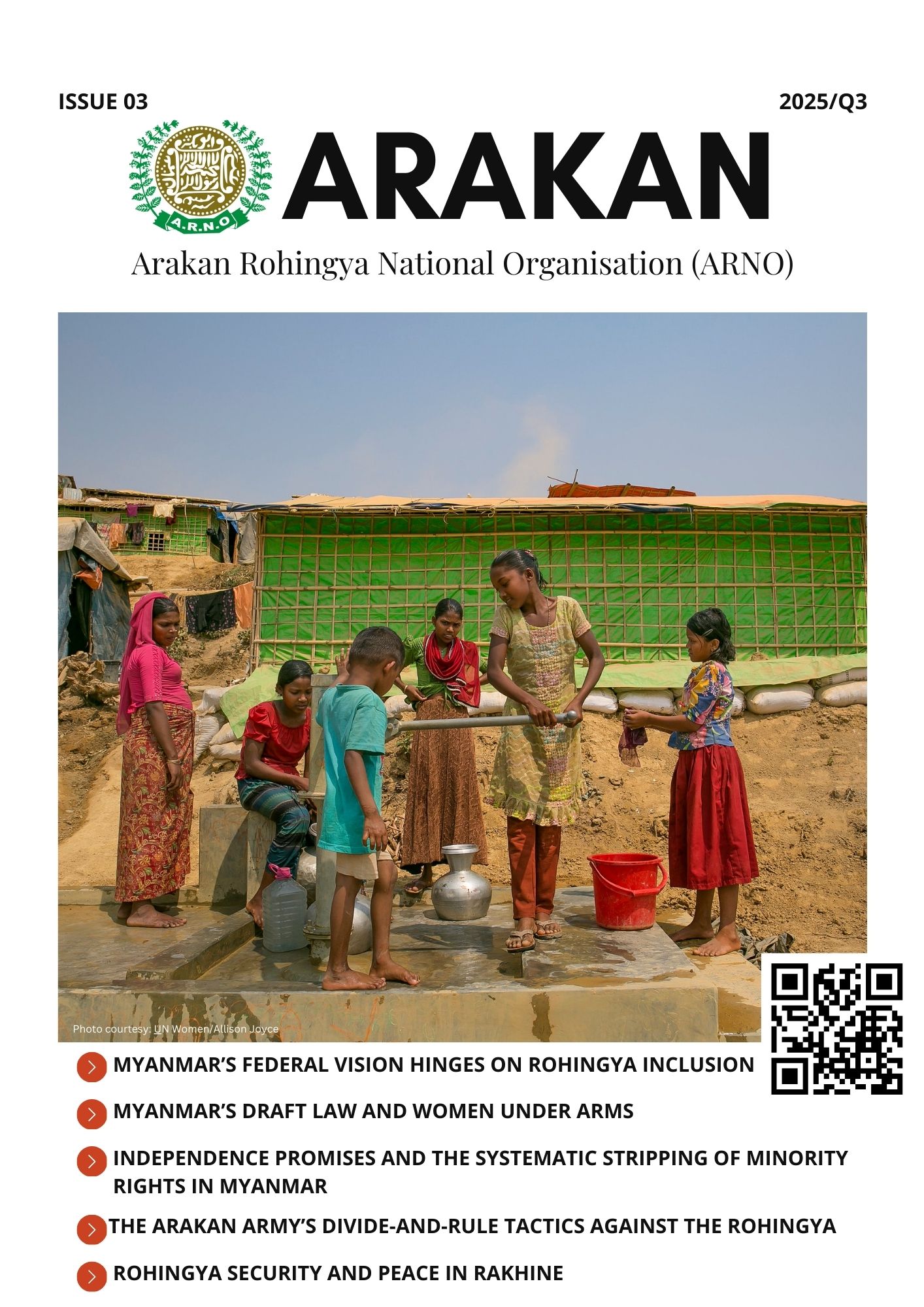
Arakan Magazine – Issue Q3/2025

In This Issue: 

  1. Editorial: Myanmar’s Federal Vision Hinges on Rohingya Inclusion
  2. Myanmar’s Draft Law and Women Under Arms
  3. Independence Promises and the Systematic Stripping of Minority Rights in Myanmar
  4. The Arakan Army’s Divide-and-Rule Tactics Against the Rohingya
  5. Rohingya Security and Peace in Rakhine
  6. IIMM Shares Evidence of Crimes Against Rohingya with International Courts
  7. Dhaka Declaration: Rohingya Speak with One Voice
  8. A Mosque Reopens in Maungdaw but What Does It Really Mean?
  9. Rohingya Women are Forced into Arakan Army Ranks
  10. On the 8th Anniversary of the Rohingya Genocide the Crisis Continues, the World Must Act
  11. ARNO Expresses Concern Over Crisis Group Report’s Misrepresentation of Rohingya Realities
  12. Eight Years On, Genocide Against Rohingya Persists

Latest News

THE RIGHT OF ARAKANESE TO SELF-DETERMINATION

The Principle of Self-Determination is one of the most important ideas in 20th century political history. It relates to the creation of new States out of the old colonial empires, to the sovereignty of Peoples and to the very basis of UN itself. Self-Determination is an essential human right, supported in the opening articles of both the major Covenants as well as in the Charter of the UN.
Self-determination emerged in the 19th century through nationalism in countries which were then parts of empires. It was an idea formed in opposition to those empires, linking up with the idea of democracy and self-rule.
read more

Cultural Problem of Muslim in Burma

One of the most important problems of the Muslims in Burma is cultural problem, which is generally termed as identity crisis. A community is recognised not only by its belief and ideology but also by the physical manifestation of the ideals it holds. Thus it constitutes a separate and distinct culture of its own.
read more

ARAKAN: AN UN-DECOLONISED COLONIAL TERRITORY

Arakan with an area of about 20,000 square miles was long famous and widely known to Arabs, Dutch, Portuguese and British traders as a centre of international trade and commerce and is situated in the tri-border region between modern day –Burma, Bangladesh and India. Although it is made a part of Burma now, it had never been so in the past. Culturally, socially, economically and politically the people of Arakan were independent for centuries. Chiefly for its geographical location, it had not only remained independent for the most part of history, but also endeavoured to expand its territory in the surrounding tracts whenever opportunity came. Completely cut off from Burma by high mountain range of Arakan Yoma, the people of Arakan neither drank from the same water with Burmans nor dependant on them for trade or commerce. Not a single river flows from Burma to Arakan and Arakan to Burma.
read more

Deprivation of Education in Arakan

(By Fayas Ahmed)
Arakan, Burma is extremely deprived of high level of illiteracy among the children as well as adults, said Hamid, who is studying in Malaysia University.
Most of the village tracts have at least one primary school (class 1 to 4). But remote areas’ admission is weakened by distance and lack of communication during the rainy season. But, widespread poverty keeps many children have to leave school as they are compelled to support to their families. Most of the students have to give up their schools during the winter and summer seasons to provide helps to their parents in their croplands. Most of the parents send their children for religious education in Madrasa and Maqtab to learn Quarn in Arabic. Furthermore, teaching in primary schools is only conveyed in Burmese language, which most of the children cannot speak and understand, said an intellectual.
read more

Fundamental Rights of Rohingya Minority

(All human beings are born free and equal in dignity and rights as per Universal Declaration of Human Rights, Article-1)
The prohibition on racial discrimination is part of customary international law. As the International Court of Justice has affirmed, protection against racial discrimination is one of those obligations that, by their very nature, "are the concern of all States. In view of the importance of the rights involved, all States can be held to have a legal interest in their protection."
read more

Burma’s Lost Kingdoms: Splendors Of Arakan by Pamela Gutman, A Book Reviews

By Habib Siddiqui
Al-Jazeerah, January 13, 2006
For centuries, before the current poisonous situation in which one community does not recognize another, Arakan was a place of harmony and mutual trust in which the two major religious communities (Rakhine Buddhists and Rohingya Muslims) thrived side by side as sister communities. All this happened because of the first of the Mrauk-U kings who had sought and got help from the Muslim Sultan of Bengal in 1430 CE to restore his kingdom. In the centuries that were to follow, the minority Muslims became essentially the royal guards, generals, ministers and advisers.
read more

Situation Report on the Rohingya People in Arakan State of Burma

By Dr. Habib Siddqui
There are over three million Rohingya people, living both inside and outside Myanmar (Burma). Due to widespread persecution, prejudice and ethnic cleansing inside Myanmar, nearly a half of the population (over 1.5 million) have been compelled to live in exile, particularly in Bangladesh, Pakistan, Saudi Arabia, U.A.E., Malaysia, and Thailand.
Rejection of Citizenship:
The Burmese military regime has declared the Rohingya non-nationals or non-citizens. The Burma Citizenship Law of 1982, which violates several fundamental principles of the customary international law, has reduced them to the status of “Stateless.”
read more

Rohingya: The Forgotten People

By Dr. Habib Siddiqui, USA
An often-practiced devious way to grab someone’s land is to deny his right to that property. Nothing could be more horrific when a government itself gets into such a criminal practice***********************************Rohningya:
The Forgotten People**********************************An often-practiced devious way to grab someone’s land is to deny his right to that property. Nothing could be more horrific when a government itself gets into such a criminal practice.
The most glaring example of such a crime can be seen in the practices of the regimes that have ruled Burma (now Myanmar) since its independence from Britain in 1948 (esp. since 1962 when Gen. Ne Win came to power).
read more

Reports

No Results Found

The page you requested could not be found. Try refining your search, or use the navigation above to locate the post.

Rohingya Library

All ABOUT ROHINGYA

Press  Release

No Results Found

The page you requested could not be found. Try refining your search, or use the navigation above to locate the post.

Experts Writing

No Results Found

The page you requested could not be found. Try refining your search, or use the navigation above to locate the post.

Rohingya History

No Results Found

The page you requested could not be found. Try refining your search, or use the navigation above to locate the post.

Rohingya Culture

No Results Found

The page you requested could not be found. Try refining your search, or use the navigation above to locate the post.

Rohingya Books

No Results Found

The page you requested could not be found. Try refining your search, or use the navigation above to locate the post.